AIDE + DM MCP Server
Give AI clients controlled access to drilling evidence
The DrillingMetrics MCP Server exposes authorized operational data, engineering context, and dashboard links as tools that compatible AI clients can call through conversation or code.
- Tool-based data access
- Authorization stays in DrillingMetrics
- Evidence-linked responses

Expose tools, not the database
Model Context Protocol (MCP) lets an AI client discover and call tools supplied by an external service. The DM MCP Server packages approved DrillingMetrics lookups as tools, so the client does not need direct database access or knowledge of internal routes.
- Retrieve active-well status, depths, rig states, KPIs, and detected events.
- Review offset performance, BHAs, surveys, reports, engineering models, and historical results.
- Return authorized dashboard links while keeping route selection and access checks inside DrillingMetrics.
Keep calculation and interpretation separate
An MCP-compatible AI client can combine tool results into an explanation or workflow while DrillingMetrics remains responsible for data access and deterministic calculations. Measurements, modeled values, detected events, and AI interpretation should remain identifiable in the response.
- Ask bounded questions about active or historical wells.
- Open the dashboard or report that supports the answer.
- Build reports and comparisons from the same authorized toolset.
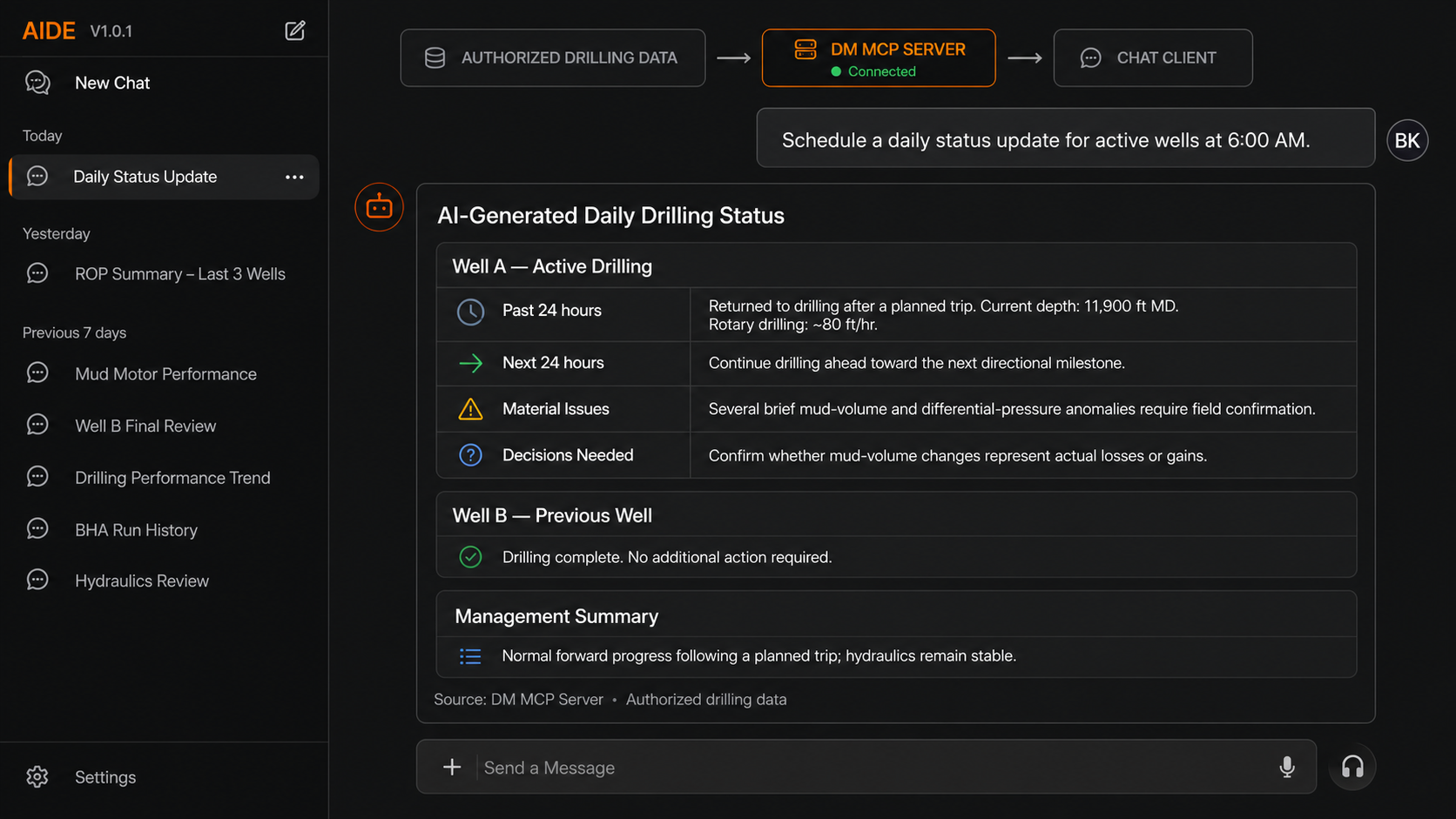
Automate a bounded daily status workflow
A scheduled workflow can summarize the past 24 hours, the next operational plan, material issues, and decisions needed across active wells. Completed wells stay separate, and automatically detected anomalies remain marked for field confirmation.
- Summarize current depth, operation, and drilling progress.
- Surface detected events that may require engineering or field review.
- Keep AI-generated conclusions tied to the available operational evidence.