A channel that departs from expectation does not identify the fault. The sensor may be biased, the physical process may have changed, or the model and context used as a reference may be wrong. Reliable surveillance separates those hypotheses with physics, supporting measurements, operating state, persistence, and explicit uncertainty.
Use physics as an independent reference
A drilling rig contains many measurements that are physically related. Pump strokes, pump displacement and pump efficiency are related to flow into the well. Flow rate, fluid properties, drillstring geometry and wellbore geometry influence circulating pressure losses.[4] Hook load is related to drillstring weight, buoyancy, trajectory, friction and operational state. Torque is related to rotation, contact forces, drilling conditions and drillstring mechanics. These relationships create something extremely useful for data validation: analytical redundancy. You do not necessarily need a second physical pressure transducer to obtain another estimate of what the pressure should be.
An engineering model using other measurements can provide an independent estimate. That estimated value will not be perfect. But it creates another piece of evidence. This is one reason Bayesian networks have been studied for drilling-data validation.[1][2][3] Despite the name, the practical idea does not require the drilling engineer to think in terms of abstract probability theory. A Bayesian network provides a structured way to connect measurements, calculated quantities and the physical relationships between them. When new evidence arrives, confidence in the measurements and relationships can change.
The method matters less than the evidence discipline: evaluate several independent physical relationships instead of judging one channel in isolation.
Keep sensor, process, and model uncertainty separate
A robust validation method should keep two questions separate: do we trust the sensor, and is the physical relationship represented by the model still behaving normally?
In a system of physically related measurements, one channel disagreeing with several mutually consistent relationships points toward a sensor problem. Several healthy channels changing together in a physically consistent way instead support a process change. SPE 166387 formalizes this distinction by maintaining beliefs in both sensors and processes.[2]
There is also a third possibility worth recognizing: The model context may be wrong. The sensors may be healthy. The physical process may be healthy. But the model could be using the wrong pump configuration, outdated mud properties, an incorrect BHA, the wrong casing geometry or another stale contextual input. In practice, these three situations can look surprisingly similar:
| Observation | Possible explanation |
|---|---|
| One measurement disagrees with several independent relationships | Sensor problem becomes more likely |
| Several measurements change together in a physically consistent way | Process change becomes more likely |
| Measurements are mutually consistent but disagree with the expected model | Model or contextual input should be checked |
The goal is not to force every anomaly immediately into one category. The goal is to systematically narrow the possibilities. Neither the sensor nor the model represents absolute truth. A sensor has limits related to accuracy and precision. An engineering model has uncertainty because it simplifies reality and depends on imperfect inputs. SPE 181076 describes data validation in terms of comparing these two sources of uncertainty.[3] Instead of treating the model estimate as an exact number, the model has an expected range. The sensor reading also has an uncertainty range.
That changes the question from:
"Does the sensor exactly match the model?"
to:
"Is the disagreement large enough that these two pieces of evidence are no longer reasonably consistent?"
This matters in real drilling data because noise and transients are unavoidable. One measurement falling outside an expected range for a few seconds should not necessarily trigger the same response as a persistent disagreement lasting several minutes. The field methodology described in SPE 181076 therefore allowed questionable behavior to accumulate before a bias fault was declared.[3] This is a useful principle for drilling analytics in general:
Persistence matters.
So does the ability to say: There is not enough information to determine the cause yet. An uncertain conclusion communicated honestly is more useful than a confident but incorrect alarm.
Gate evidence by operating context and time
Physics-based validation only works if the physics model represents the operation that is actually taking place. That requires contextual data. The field implementation described in SPE 181076 required information including pump specifications, mud-motor information, BHA data, casing information, mud properties and traveling-block weight in addition to the real-time sensor channels.[3] This creates an important data-engineering problem. Real-time sensor measurements may arrive every second. Mud properties might be updated every few hours. A BHA may change once during a run. Directional surveys arrive intermittently. Equipment specifications may come from a separate reporting system entirely.
All of these data sources have to be associated with the correct portion of the drilling operation. Otherwise, a perfectly healthy sensor can disagree with a model simply because the model is describing the wrong physical system. This is why synchronization and contextualization are not administrative details. They are part of the engineering calculation. A sophisticated anomaly-detection algorithm operating on poorly synchronized or stale contextual data can be less useful than a simple plot reviewed by an experienced engineer.
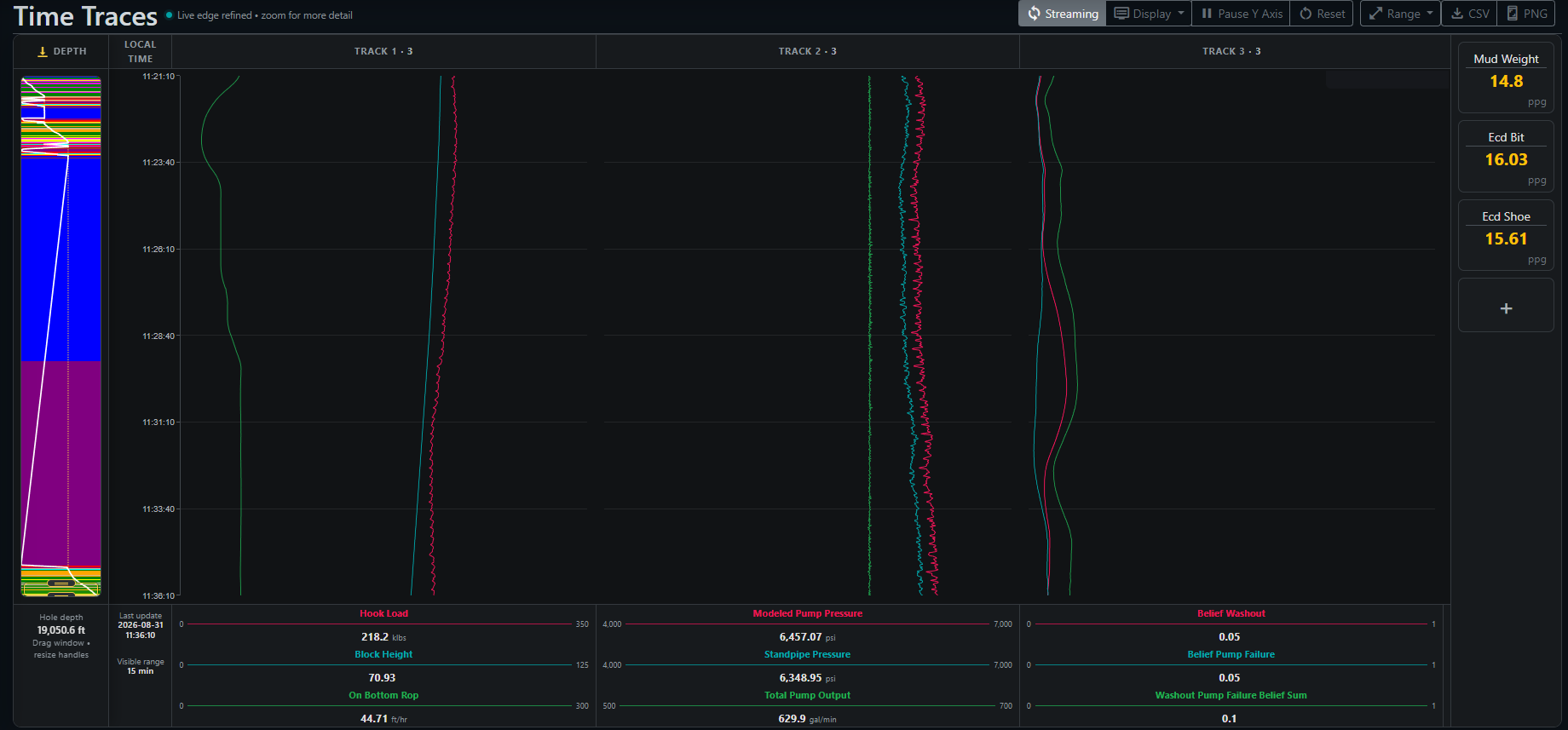
Real-time drilling measurements are most useful when interpreted alongside the current operational state and well context.
Worked example: a standpipe-pressure drop
In a hypothetical interval, pumps operate near a steady rate and SPP has been stable around 4,800 psi. Over several minutes, measured pressure falls toward 4,500 psi. A simple alarm sees only a 300-psi drop; a useful diagnostic tests five questions:
| Question | Evidence to check |
|---|---|
| Is the measurement obviously bad? | Missing or impossible values, discontinuities, flat-line behavior, and communications. A plausible 4,500-psi reading requires further diagnosis. |
| Has configuration changed? | Pump liners and efficiency, mud properties, BHA, nozzles, and whether model context is current. |
| Do supporting channels agree? | Pump rate, flow, and other hydraulic indicators. Coordinated change supports a process event; an isolated pressure departure supports a sensor problem. |
| What was the rig doing? | Steady rotary drilling, pump ramping, connections, downlinks, and other transitions have different expected behavior. |
| Is the disagreement persistent? | A brief transient may need no action; a growing multi-minute residual deserves more weight. |
The result may favor a sensor fault, a valid process change, or an unresolved state. All three are legitimate outcomes.
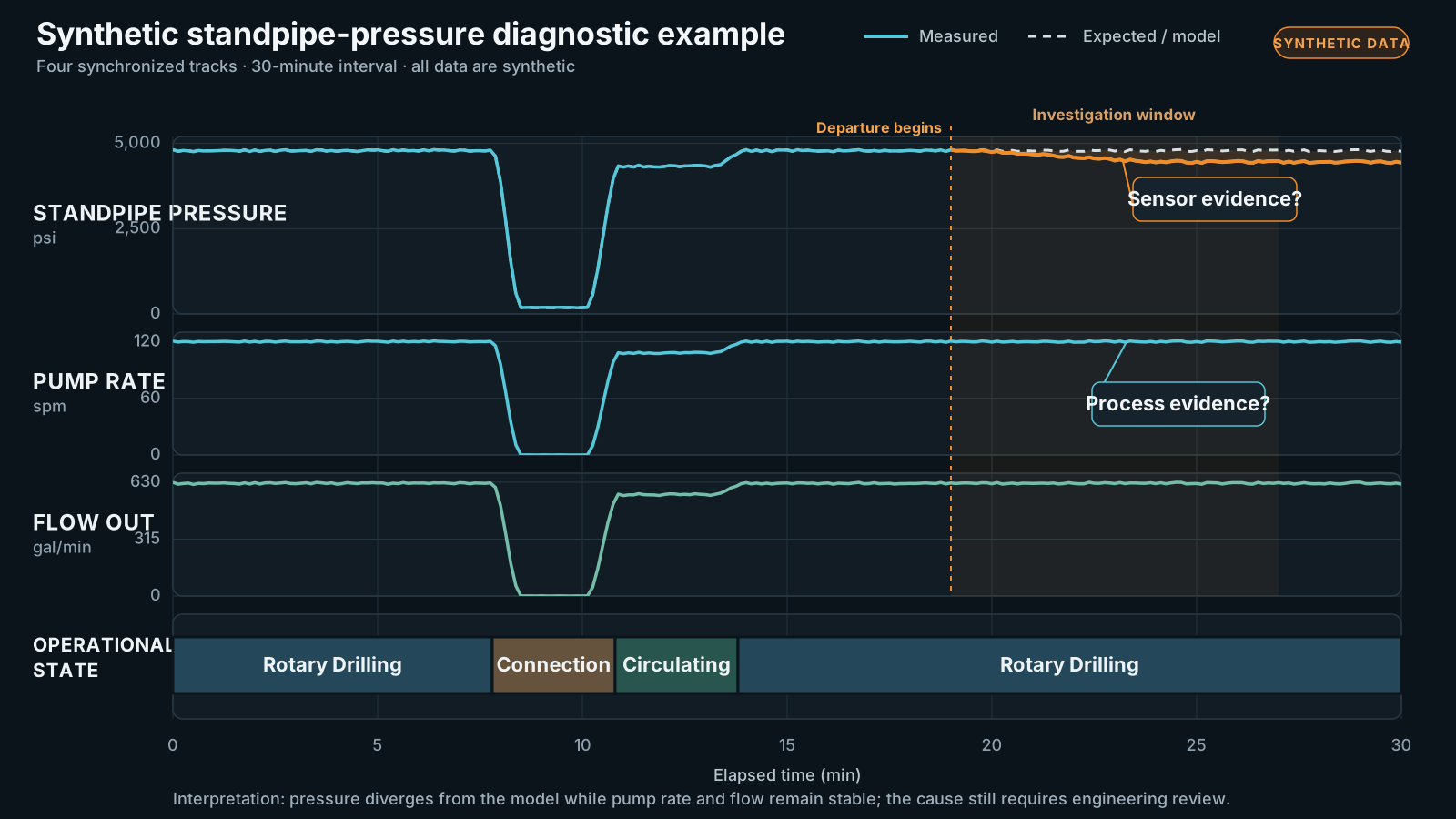
An abnormal pressure trend becomes more meaningful when pump behavior, flow measurements, modeled expectations, and operational state are evaluated together.
Make the conclusion inspectable
The conclusion still has to be trusted by the person making the decision. In the SPE 181076 field trial, measured and model-estimated values were displayed together when evaluating questionable channels.[3] Instead of showing only STANDPIPE PRESSURE SENSOR FAULT, expose the evidence that produced it:
- measured pressure,
- expected/model pressure,
- relevant supporting channels,
- the current operational state,
- how long the disagreement has persisted,
- and whether the diagnosis is confident or uncertain.
This does not mean overwhelming the driller with every intermediate calculation. It means exposing enough evidence that an engineer can understand why the system reached its conclusion. There are two mistakes a drilling surveillance system should avoid. The first is trusting every sensor unconditionally. The second is trusting the model unconditionally. A measured value is evidence. A model prediction is also evidence. Neither should automatically overrule the other. Reliable interpretation comes from combining independent measurements, physical relationships, operational context and uncertainty. That approach does not eliminate ambiguity. In some situations, the available sensor network simply cannot uniquely distinguish a measurement problem from a process change. SPE 166387 explicitly discusses cases where the available relationships are insufficient to separate the two.[2]
Recognizing that limitation is itself a sign of a mature analytics system. When the evidence is strong, the system should help identify what changed. When the evidence is incomplete, it should show what is known and what remains uncertain. And when the measurements themselves cannot be trusted, that should be established before those measurements become the basis for the next engineering decision.
Related technical resources
- Using Physical Models as Real-Time Reference Signals in Drilling Analytics
- When “Unable to Determine” Is the Correct Output in Drilling Analytics
References
-
Ashok, P., Ambrus, A., and van Oort, E. Automatic Sensor Data Validation: Improving the Quality and Reliability of Rig Data. SPE 163726-MS, SPE Digital Energy Conference and Exhibition, The Woodlands, Texas, 2013.
-
Ambrus, A., Ashok, P., and van Oort, E. Drilling Rig Sensor Data Validation in the Presence of Real-Time Process Variations. SPE 166387-MS, SPE Annual Technical Conference and Exhibition, New Orleans, Louisiana, 2013.
-
Ashok, P., Ambrus, A., Ramos, D., Lutteringer, J., Behounek, M., Yang, Y. L., Thetford, T., and Weaver, T. A Step by Step Approach to Improving Data Quality in Drilling Operations: Field Trials in North America. SPE 181076-MS, SPE Intelligent Energy International Conference and Exhibition, Aberdeen, United Kingdom, 2016.
-
Shahri, M., Kutlu, B., Thetford, T., et al. Adopting Physical Models in Real-Time Drilling Application: Wellbore Hydraulics. SPE 191797-MS, SPE Liquids-Rich Basins Conference, North America, Midland, Texas, 2018.