A physical model is often more valuable as a dynamic reference than as a precise forecast. Comparing measured and expected behavior produces a residual that can expose process change, sensor bias, stale context, or model error. The residual becomes trustworthy only when the model is verified, locally calibrated, state-gated, and explicit about uncertainty.
Use the residual as an analytical variable
Drilling models are often introduced as predictive tools. Examples include:
- expected standpipe pressure,
- ECD,
- hook load,
- torque,
- directional tendency.
Those predictions are valuable. In real-time surveillance, the model also supplies a time-varying reference, and the difference between observed and expected behavior becomes an analytical variable.
This is similar to the way an engineer interprets a broomstick plot. A measured pick-up weight of 400 klbf is interpreted relative to what the torque-and-drag model predicts for:
- current depth,
- trajectory,
- pipe configuration,
- mud,
- friction assumptions.
The expected value creates context. Let:
$$\hat{y}_t = f( x_t, c_t, \theta_t )$$
where:
- \(\hat{y}_t\) = model-expected value,
- \(x_t\) = real-time operating inputs,
- \(c_t\) = contextual information,
- \(\theta_t\) = model/calibration parameters.
Then define:
$$r_t = y_t - \hat{y}_t$$
where:
- \(y_t\) = measured field value,
- \(r_t\) = residual.
Monitoring \(r_t\) alongside \(y_t\) often makes change easier to interpret. Multiple pressure sensors provide hardware redundancy; a model built from flow, RPM, mud properties, and drillstring geometry provides analytical redundancy by estimating standpipe pressure. We now have:
- Measurement: Pressure sensor.
- Analytical estimate: Hydraulic model.
The second pressure value comes from physical relationships among other measurements, not another gauge. Published drilling-data validation work calls this relational redundancy. A measured pressure far below the model can have several causes:
| Source of disagreement | Examples |
|---|---|
| Process | Drillstring washout, pump degradation, another hydraulic change |
| Sensor | Pressure bias, pump-output error, flow-measurement error |
| Context | Wrong nozzle area, stale mud properties, incorrect BHA geometry |
| Model | Friction assumptions, rheological simplification, unmodeled transients |
A large residual establishes disagreement between measured and expected behavior, not a specific fault. It starts the diagnosis; it does not complete it.
Model uncertainty and validity matter
This prevents an important mistake. A model is not ground truth. SPE-181076 explicitly notes that:
- sensor readings have uncertainty,
- model estimates have uncertainty.
Disagreement does not automatically make the measurement wrong; the model may be wrong. That uncertainty should remain visible in the interpretation. A relatively simple steady-state hydraulic model may be adequate for:
- land drilling,
- stable circulation,
- detecting a large pressure departure.
The same model may not be adequate for:
- MPD choke transients,
- multiphase flow,
- narrow offshore operating windows,
- strong temperature/pressure effects.
SPE-191797 makes this application dependence explicit: model selection should reflect the accuracy and physical requirements of the intended operation. This is a useful engineering rule:
The model only needs to be as sophisticated as the decision requires, but no less.
Before a model becomes a real-time reference, engineers need evidence that it behaves correctly. A useful validation sequence is:
- Mathematical verification: Does the implementation reproduce the intended equations?
- Benchmark verification: Does it agree reasonably with trusted software, numerical simulation, or known solutions?
- Field validation: Does it agree with measured behavior under appropriate operating conditions?
SPE-191426, for example, verified its torque-and-drag engine against an industry-standard model before using it operationally. SPE-191797 compared its hydraulic approach with other calculations and field PWD information before applying it to real-time surveillance. The reference must itself be credible before its residual becomes meaningful.
Calibrate without hiding degradation
A generic torque-and-drag model contains:
- geometry,
- friction,
- pipe properties.
But the current well may behave differently from nominal assumptions. The model is therefore calibrated. For example, \(\mu_{openhole}\) can be adjusted so predicted hook load better matches measured:
- pick-up,
- slack-off
behavior. The model then represents this well under current conditions rather than a generic well with textbook inputs. If modeled trip-out hook load initially differs from actual data, a calibration algorithm can estimate an open-hole friction factor that improves the fit. As depth changes, friction behavior may also change. The calibrated expected hook-load trace becomes the reference. A later measured departure above it is more meaningful than comparison against a poorly calibrated generic model.
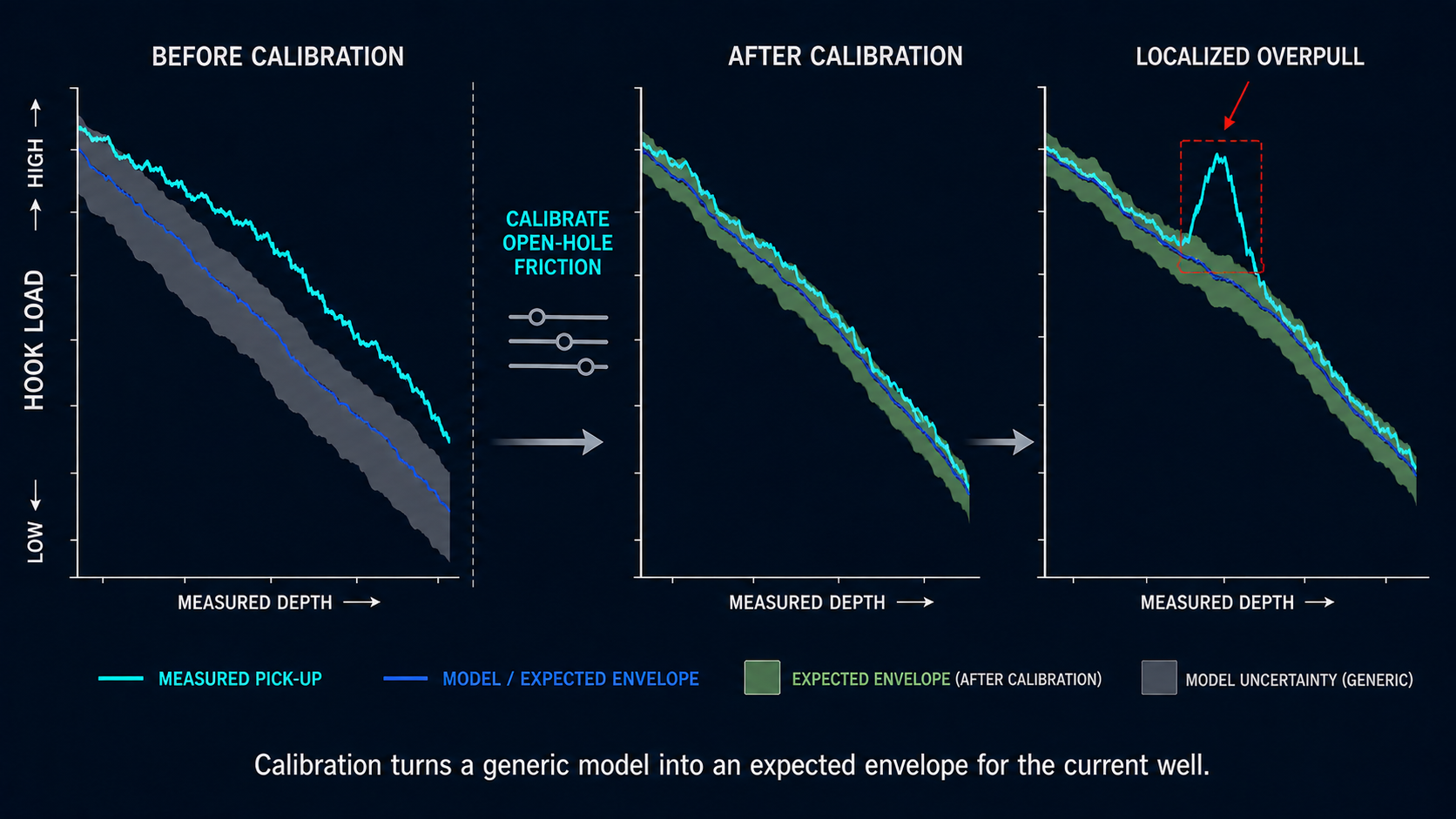
Field calibration aligns the torque-and-drag model with current-well behavior, creating a local envelope against which a later overpull can be evaluated.
If measured hook load gradually increases because hole condition is worsening, continuous friction recalibration can keep the residual small by learning the developing problem as the new normal. This is baseline drift. Calibration therefore needs engineering boundaries: not every deviation should become a new calibration when the disagreement may be the signal the surveillance system is meant to detect.
Gate the model with state and context
Torque-and-drag provides an excellent example. Hook load during:
- pick-up,
- slack-off,
- rotating off-bottom
represents different mechanical conditions. Calibration should not pool them blindly. SPE-191426 used rig-state identification before model calibration, making state part of the model-input validity logic.
This reinforces the earlier article on why rig-state classification is foundational. A hydraulic model may need:
- mud rheology,
- BHA geometry,
- nozzle area,
- hole size,
- casing ID.
A torque-and-drag model may need:
- trajectory,
- pipe properties,
- mud weight,
- BHA,
- casing depth.
These inputs often come from:
- reports,
- plans,
- engineering databases.
That creates another residual failure mode: context error. If a bit changes but the new nozzle configuration is not entered, measured pressure changes while the model remains based on the previous bit. The residual grows even though the rig process may be healthy because the expected signal is stale.
Worked hydraulics interpretation
A hypothetical rotary interval develops a large negative pressure residual:
| State | Flow | Measured SPP | Model SPP | Residual |
|---|---|---|---|---|
| Normal | 650 gpm | 5,100 psi | 5,060 psi | +40 psi |
| Later | 648 gpm | 4,760 psi | 5,070 psi | −310 psi |
Now inspect supporting evidence.
| Supporting evidence | Interpretation |
|---|---|
| Flow-out and pump-output data remain stable; pressure is corroborated | A real circulating-system change becomes more plausible |
| Pump output suddenly reports 320 gpm while flow-out and pressure remain near prior levels | Pump-output measurement failure becomes more plausible |
| The bit changed but the new nozzle area was not entered | The model context is stale |
Each case begins with measured behavior disagreeing with expected behavior, but the causes differ. That is why the residual starts the investigation rather than finishing it.
Expose applicability and evidence
If a model is used as a surveillance reference, the system should expose whether it is currently usable:
- Valid: Inputs current and operating state appropriate.
- Degraded: Some inputs uncertain or estimated.
- Not applicable: Operating state outside model assumptions.
- Recalibration Required: Residual drift suggests the reference may no longer represent normal operation.
This avoids treating model output as equally trustworthy at all times. A steady-state hydraulic model evaluated during pump ramp-up or severe transient operation may produce a large residual simply because its assumptions do not apply. The correct output is then do not evaluate this residual here. Model applicability is part of analytical validity. When an alert does fire, the engineer can review:
- Measured value: 4,760 psi.
- Expected value: 5,070 psi.
- Residual: −310 psi.
Inputs
- flow = 648 gpm,
- current mud properties,
- current BHA,
- current geometry.
Supporting evidence
- flow-out,
- rig state,
- pump behavior.
This is far more explainable than:
AI detected a hydraulic anomaly.
The model supplies a physical reason for concern. A useful model display often shows:
- measured trace,
- expected trace,
- perhaps uncertainty band.
This lets the engineer see:
- agreement,
- departure,
- persistence.
A single Residual = −310 psi value is useful, but paired traces show how the disagreement developed.
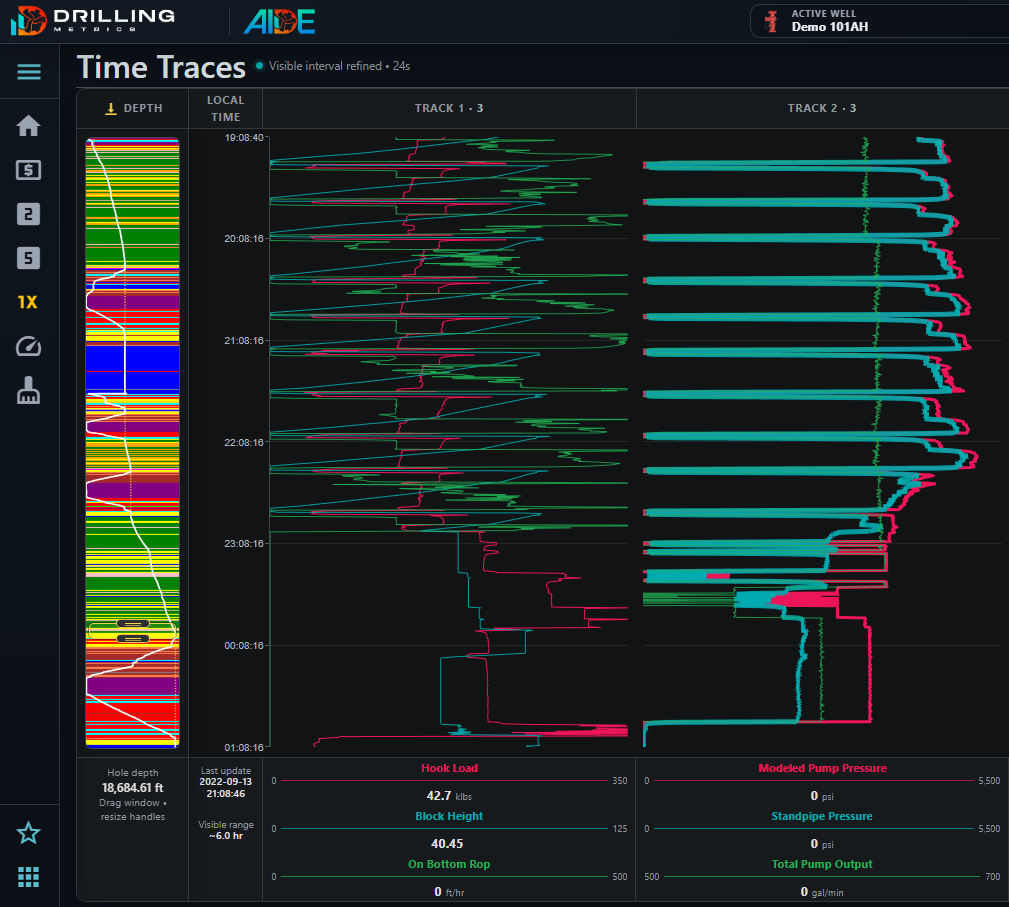
DrillingMetrics time traces from an interval with a confirmed drill-pipe washout. Modeled pump pressure and measured standpipe pressure track through earlier circulation cycles and then separate; the divergence is the analytical signal, while the washout interpretation depends on supporting measurements and operational context.
Related technical resources
- Distinguishing Sensor Faults from Real Drilling Process Changes
- Distinguishing Drillstring Washouts from Mud-Pump Failures in Real Time
- Real-Time Torque and Drag Is a Calibration Problem, Not Just a Modeling Problem
References
-
Shahri, M., Kutlu, B., Thetford, T., Nelson, B., Wilson, T., Behounek, M., Ambrus, A., and Ashok, P. Adopting Physical Models in Real-Time Drilling Application: Wellbore Hydraulics. SPE-191797-MS, SPE Liquids-Rich Basins Conference, North America, Midland, Texas, 2018.
-
Shahri, M., Wilson, T., Thetford, T., Nelson, B., Behounek, M., Ambrus, A., D'Angelo, J., and Ashok, P. Implementation of a Fully Automated Real-Time Torque and Drag Model for Improving Drilling Performance: Case Study. SPE-191426-MS, SPE Annual Technical Conference and Exhibition, Dallas, Texas, 2018.
-
Ashok, P., Ambrus, A., Ramos, D., Lutteringer, J., Behounek, M., Yang, Y. L., Thetford, T., and Weaver, T. A Step by Step Approach to Improving Data Quality in Drilling Operations: Field Trials in North America. SPE-181076-MS, SPE Intelligent Energy International Conference and Exhibition, Aberdeen, Scotland, 2016.