Distinguishing Drillstring Washouts from Mud-Pump Failures in Real Time
A falling standpipe pressure can indicate several very different problems. The diagnosis becomes clearer when pressure is interpreted together with flow, pump behavior, hydraulic modeling, and operational context.
A sudden or gradual loss of standpipe pressure will get the attention of almost any drilling crew.
One possible explanation is a drillstring washout.
Another is degradation of a mud pump.
Those failures occur in very different parts of the circulating system, but from the rig floor they can initially look remarkably similar.
In both cases, standpipe pressure can decrease.
If the diagnosis stops there, the pressure trace tells us that something changed—but not necessarily what changed.
This makes washout detection a useful example of a broader principle in real-time drilling analytics:
An abnormal measurement becomes much more useful when it is interpreted as part of a physical system rather than as an isolated channel.
Published work in IADC/SPE-189700 investigated this exact problem by combining standpipe pressure, pump rate, flow-out behavior, hydraulic relationships, operational context, and hydraulic-model predictions to distinguish drillstring washouts from mud-pump failures.[1]
The important lesson is not a particular alert threshold or algorithm.
It is the engineering logic behind the diagnosis.

A pressure decrease can result from a drillstring leak or reduced pump performance; the surrounding hydraulic evidence separates the two.
Why Standpipe Pressure Alone Is Ambiguous
The simplest washout signature is familiar:
pump rate remains approximately constant while standpipe pressure decreases.
A leak in the drillstring creates an additional flow path before the fluid reaches the intended restriction farther down the circulating system. As the leak grows, the hydraulic resistance seen at surface can decrease.
The problem is that a mud pump that is no longer delivering the expected volume can also reduce standpipe pressure.
Damage to components such as:
- liners,
- pistons,
- suction valves,
- discharge valves,
can reduce actual pump performance even though the surface pump command or stroke counter appears relatively normal.
IADC/SPE-189700 notes that both drillstring washouts and pump degradation can therefore produce declining standpipe pressure.[1]
And there are still more possibilities.
Pressure behavior can also be influenced by:
- changing pump rate,
- changing mud properties,
- bit nozzle condition,
- fluid compressibility,
- downlinking activity,
- pressure transients,
- changing circulating geometry,
- plugged restrictions,
- or bad pressure or pump-output measurements.
So the engineering question should not be:
Did standpipe pressure decrease?
It should be:
Did standpipe pressure decrease in a way that is consistent with the rest of the circulating system?
That is a much stronger diagnostic question.
Start With the Expected Hydraulic Relationship
Standpipe pressure is not independent of the rest of the operation.
For a given circulating configuration, pressure depends on quantities such as:
- flow rate,
- mud rheology,
- drillpipe and BHA geometry,
- bit nozzle area,
- hole and casing geometry,
- motor pressure loss,
- pipe rotation,
- eccentricity,
- and other hydraulic effects.
That means an engineering hydraulic model can provide an expected pressure for the current operating condition.
SPE-191797 describes the application of a computationally efficient hydraulic model in real-time drilling using streaming data together with contextual information such as mud properties, BHA geometry, and wellbore geometry.[2]
The useful comparison then becomes:
Measured Standpipe Pressure
versus
Modeled Standpipe Pressure
Suppose the pumps continue operating at a stable reported rate.
The hydraulic model predicts approximately 4,700 psi.
Measured pressure has historically tracked the prediction reasonably well.
Then the measured pressure begins falling:
4,650 psi
4,550 psi
4,400 psi
4,250 psi
while the model remains near 4,700 psi.
That divergence contains more information than the pressure trace alone.
Something about the real hydraulic system is no longer represented by the assumed normal condition.

A growing difference between measured and expected pressure provides stronger evidence of a hydraulic change than pressure magnitude alone.
But that still does not tell us whether the problem is a washout or the pump.
For that, another measurement becomes especially useful.
Flow Out Helps Separate the Two Failure Modes
The key difference lies in where the fluid is going.
During a drillstring washout
Fluid leaks from inside the drillstring into the annulus before reaching its intended location farther downhole.
But much of that fluid still remains inside the overall circulating system.
Instead of flowing:
surface → drillstring → bit → annulus → surface
some fluid takes a shorter path:
surface → drillstring → washout → annulus → surface
Pressure decreases because the hydraulic path has changed.
But the fluid can still return to surface.
Therefore, in a simplified washout scenario:
- reported pump rate remains relatively constant,
- standpipe pressure decreases,
- flow out remains approximately constant.
During pump degradation
The pump itself is delivering less fluid than expected.
The stroke counter may still indicate a normal rate, but volumetric efficiency has deteriorated.
Now the actual flow entering the well decreases.
The expected pattern becomes:
- reported pump strokes remain approximately constant,
- standpipe pressure decreases,
- actual flow into the well decreases,
- flow out eventually decreases as well.
That makes flow out one of the most useful discriminating measurements.
The field methodology described in IADC/SPE-189700 identified flow-out behavior as the primary practical distinction between the two failure modes.[1]
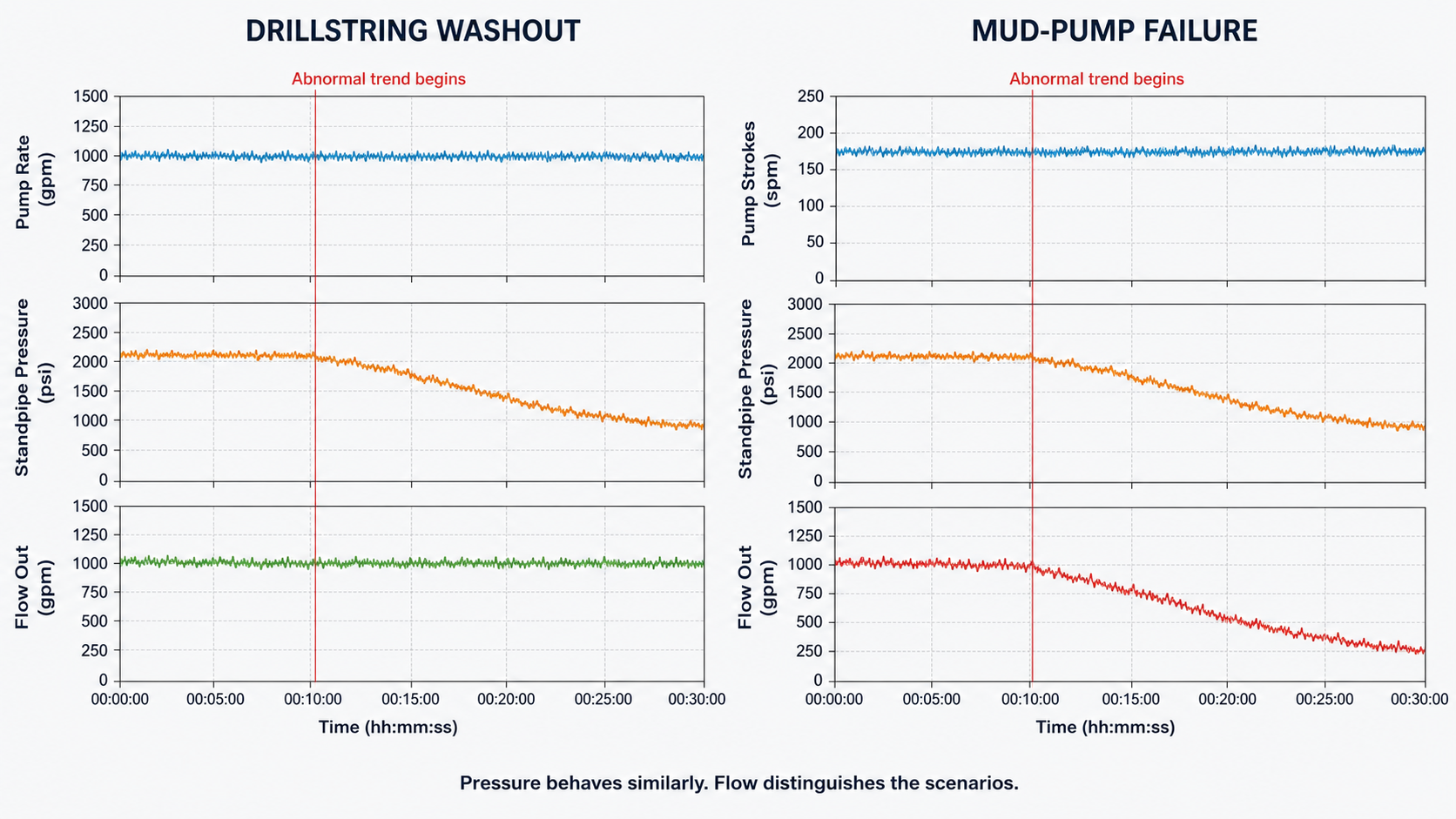
![Synthetic engineering traces comparing drillstring washout and mud-pump failure: pump activity remains stable and standpipe pressure decreases in both cases, while flow out stays stable during a washout and decreases during pump failure.]/static/assets/img/resources/drillstring-washout-vs-mud-pump-failure/washout-vs-pump-failure-traces.png)
Washouts and pump failures can produce similar pressure behavior; flow-out trends provide an important means of separating them.
Pressure Divided by Flow Squared Adds Another Perspective
The pressure-flow relationship can also be examined directly.
IADC/SPE-189700 used a simple hydraulic coefficient of the general form:
$$ h = \frac{P}{Q^2} $$
where:
- (P) is standpipe pressure,
- (Q) is flow rate.
This is not intended to replace a complete hydraulic model.
It creates a convenient way to monitor whether the relationship between pressure and flow is changing over time.
Two versions can be considered:
$$ h_{\mathrm{in}} = \frac{P}{Q_{\mathrm{in}}^2} $$
and
$$ h_{\mathrm{out}} = \frac{P}{Q_{\mathrm{out}}^2} $$
The interesting part is how these coefficients behave under different failures.
Washout
If pressure decreases while flow out remains approximately constant:
$$ P \downarrow,\quad Q_{\mathrm{out}} \approx \mathrm{constant} $$
then:
$$ h_{\mathrm{out}} \downarrow $$
The pressure-to-flow relationship has changed.
Pump degradation
If pressure and actual flow out both decrease together, the flow-out coefficient can remain comparatively stable.
The published methodology found this behavior useful in differentiating pump degradation from washout.[1]
This illustrates another valuable analytics principle:
Derived relationships can expose changes that are difficult to see by looking at raw channels individually.
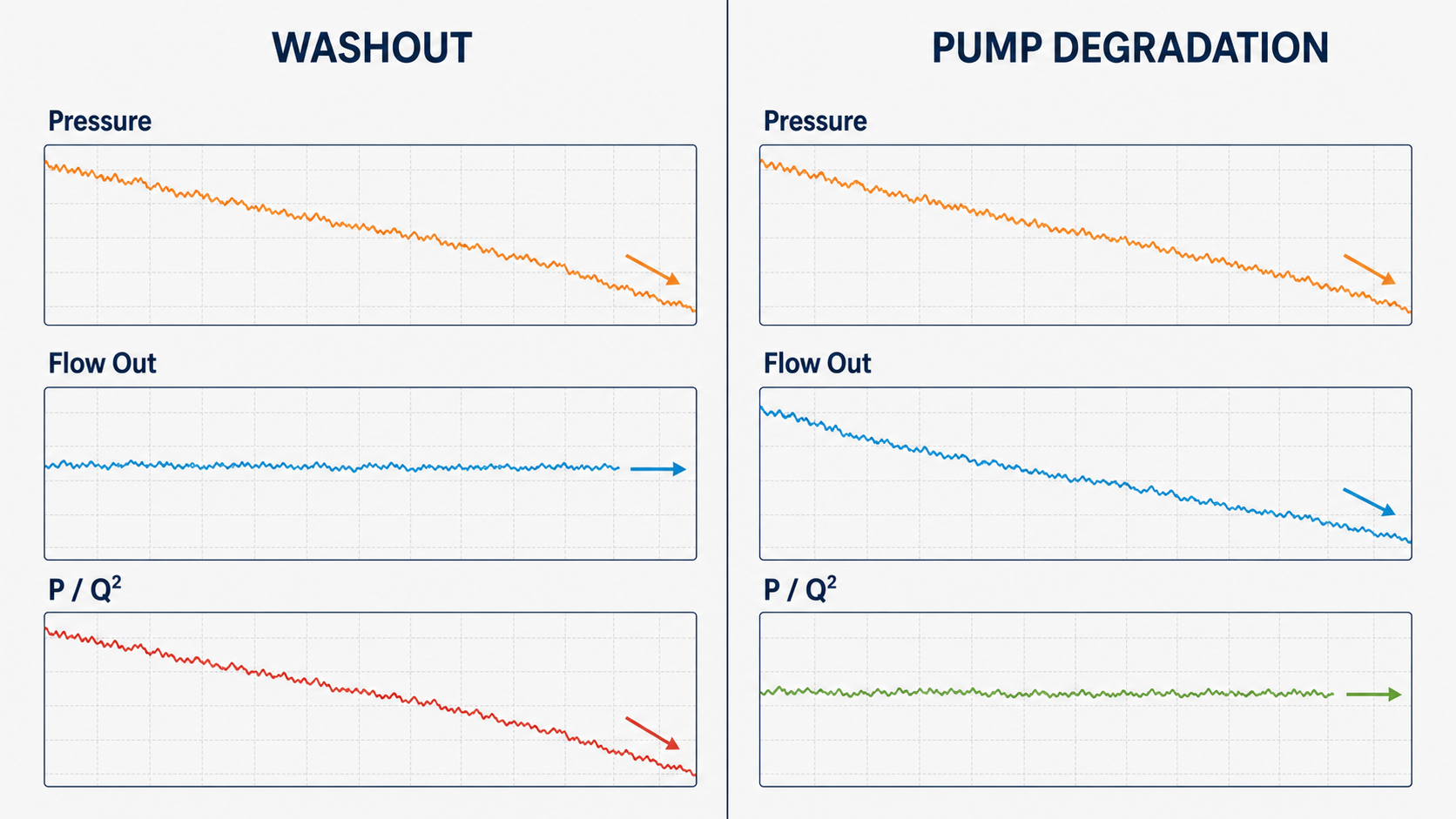
Monitoring the pressure-to-flow relationship provides additional evidence about whether hydraulic resistance changed or actual pump delivery declined.
Short-Term and Long-Term Behavior Tell Different Stories
Not every washout happens instantaneously.
A crack or erosion point can enlarge gradually.
A pump can also lose efficiency progressively.
That creates an important time-series problem.
A rapid event may be obvious in a short trend window.
A slowly developing failure may be almost invisible over the same interval.
The published IADC/SPE-189700 implementation addressed this by analyzing different features over different time horizons.[1]
For example, the study evaluated:
- relatively short pressure trends for sudden changes,
- pressure-to-flow relationships over stable pumping periods,
- and much longer trends to identify progressive changes.
The exact window lengths used in that implementation are less important than the underlying principle:
The detection horizon should match the time scale of the physical process.
A two-minute view may be excellent for a sudden pressure step.
It may be poor for recognizing a six-hour degradation trend.
Conversely, a six-hour average can hide the exact point at which a sudden event began.

Different time horizons are needed to detect abrupt events and slowly developing equipment degradation.
Operational State Matters
A pressure change while drilling is not necessarily interpreted the same way as a pressure change while:
- pumps are ramping,
- pumps are staging,
- circulating off bottom,
- reaming,
- downlinking,
- making a connection,
- or performing another operation.
IADC/SPE-189700 incorporated rig activity and pump status into the event interpretation because failure likelihood and expected channel behavior depend on what the rig is actually doing.[1]
This prevents another common analytical mistake:
comparing measurements generated under different operating conditions as though they represented the same process.
For example, a drop in pressure while the pump rate is being intentionally reduced is not evidence of a washout.
The diagnosis only becomes interesting when:
- the operating condition should produce stable hydraulic behavior,
- but the measurements begin departing from that expectation.
This is why rig-state detection and event detection are tightly connected in real-time drilling analytics.
Validate the Sensors Before Diagnosing the Equipment
There is another possibility that should be considered before concluding that either failure has occurred:
the measurement itself may be wrong.
Suppose total pump output suddenly falls by 50%.
That looks important.
But standpipe pressure remains unchanged.
Flow out remains unchanged.
The drilling operation appears unaffected.
That combination makes an actual 50% reduction in circulating rate physically difficult to reconcile.
SPE-181076 documents a field example with essentially this behavior: a measured pump-output value dropped significantly while flow out and standpipe pressure remained stable, allowing the system to identify the pump-output measurement itself as questionable.[3]
Similarly, SPE-191797 describes using a real-time hydraulic model to validate pump-output and standpipe-pressure measurements before interpreting deviations as process failures.[2]
This creates a useful hierarchy:
- Is the signal valid?
- Did the hydraulic process change?
- If it changed, which failure mechanism best explains the evidence?
Skipping the first question can turn a bad sensor into an unnecessary equipment investigation.
What Happens When Flow Out Is Missing?
This may be the most useful result in the entire study.
Suppose:
- pump strokes remain constant,
- standpipe pressure decreases,
- measured pressure falls below modeled pressure.
Those observations support both a washout and pump degradation.
Now remove the flow-out measurement.
Can the system still confidently determine which event occurred?
Not necessarily.
IADC/SPE-189700 explicitly demonstrated a scenario in which an unavailable flow-out measurement caused the washout and pump-failure probabilities to become indistinguishable.[1]
That is important because it demonstrates something mature analytics systems should be allowed to say:
There is not enough evidence to distinguish the two failure modes.
The answer should not be manufactured simply because software is expected to output one.
This is especially relevant to drilling data, where:
- sensors may fail,
- channels may not be installed,
- values may be stale,
- and some rigs have substantially better instrumentation than others.
A system that reports uncertainty appropriately can be more useful than one that always produces a confident classification.

When a discriminating measurement is unavailable, the technically correct outcome may be an unresolved diagnosis rather than a forced classification.
A Practical Diagnostic Workflow
Suppose the rig is rotary drilling.
Pump strokes are stable.
Standpipe pressure begins declining.
A practical diagnostic sequence could look like this.
1. Confirm the operating condition
Verify that:
- the pumps are fully staged,
- pump set points have not intentionally changed,
- the rig has not just entered a transient operation.
2. Check the pressure measurement
Look for:
- flatlining,
- discontinuities,
- communication issues,
- disagreement with related channels.
A bad pressure signal should not immediately become a washout diagnosis.
3. Compare measured and expected pressure
Use the current:
- flow rate,
- mud properties,
- BHA,
- bit nozzles,
- wellbore geometry,
- motor,
- and current operating state.
If measured pressure is increasingly below the expected hydraulic pressure, evidence of a real process change increases.
4. Examine flow out
If flow out remains approximately stable while pressure continues falling, a change in hydraulic resistance—such as a washout—becomes more plausible.
If flow out also declines, reduced actual pump delivery becomes more plausible.
5. Evaluate the pressure-to-flow relationship
Monitor whether (P/Q^2) remains relatively stable or begins trending downward.
This can make the difference between:
pressure changed because flow changed
and
pressure changed even though flow remained similar.
6. Examine persistence
A brief transient and a multi-hour trend should not receive the same interpretation.
Ask:
- Is the divergence growing?
- Is it recurring?
- Does it persist across several stable pumping periods?
7. Look for competing explanations
Before taking action, consider whether the behavior could be explained by:
- changes in rheology,
- altered pump configuration,
- bit-nozzle changes,
- plugging,
- lost circulation,
- sensor degradation,
- or other hydraulic events.
The objective is not to prove a favorite diagnosis.
It is to identify which physical explanation best fits the complete evidence.

Flow-out behavior helps weigh competing explanations for a pressure decrease while preserving uncertainty when evidence is incomplete.
Field Evidence Shows Why Early Detection Matters
The methodology published in IADC/SPE-189700 was evaluated across more than 100 onshore wells and deployed across multiple North American rigs.[1]
One documented washout case generated several automated alerts before the crew ultimately tripped because of pressure loss.
The first alert occurred more than six hours before the trip.[1]
That result should not be interpreted as a universal promise that washouts can always be predicted six hours in advance.
The more useful observation is that some mechanical failures develop progressively enough to create detectable signatures before the final event.
That creates an opportunity for real-time surveillance.
Instead of asking only:
Has the equipment failed?
we can ask:
Is the hydraulic relationship progressively moving away from its normal operating behavior?
That is a fundamentally different surveillance philosophy.
Sometimes More Than One Failure Is Occurring
Real drilling operations also resist neat classifications.
A washout may occur while a pump is simultaneously degrading.
A swivel may leak.
A flow sensor may become unreliable at the same time an actual hydraulic event develops.
IADC/SPE-189700 discusses the difficulty created by overlapping signatures and even presents field cases involving mixtures of pump and other hydraulic problems.[1]
This is another reason to avoid treating event classification as a collection of simple rules:
Pressure down + strokes constant = washout.
Real operations are rarely that clean.
A better approach is to accumulate evidence for competing explanations and update the interpretation as new measurements arrive.
Detection and Diagnosis Are Different Tasks
There is a useful distinction between these two questions:
Is something abnormal happening?
and
What exactly is happening?
The first may be relatively easy.
If:
- pressure is declining,
- pump operation appears stable,
- and measured pressure increasingly disagrees with the hydraulic model,
there may be strong evidence that the circulating system is behaving abnormally.
Determining whether that abnormality is:
- a washout,
- pump degradation,
- a sensor problem,
- or another hydraulic event
requires more evidence.
The published alerting approach recognized this distinction by first identifying the combined likelihood of a washout/pump-failure type event and then using additional flow behavior to help determine which failure was more likely.[1]
This is a useful design principle for drilling surveillance generally:
Detect the abnormal condition at the level supported by the evidence. Increase diagnostic specificity only as the evidence allows.
The Goal Is Not More Alarms
A surveillance system that generates hundreds of hydraulic alerts is not necessarily safer than one that generates ten.
The important questions are:
- Are the alerts meaningful?
- Do they persist long enough to be operationally relevant?
- Is the evidence visible?
- Can the engineer understand why the alert occurred?
- Does the system distinguish uncertainty from confidence?
The best real-time analytics reduce the amount of raw data an engineer has to continuously watch without hiding the evidence necessary to make a decision.
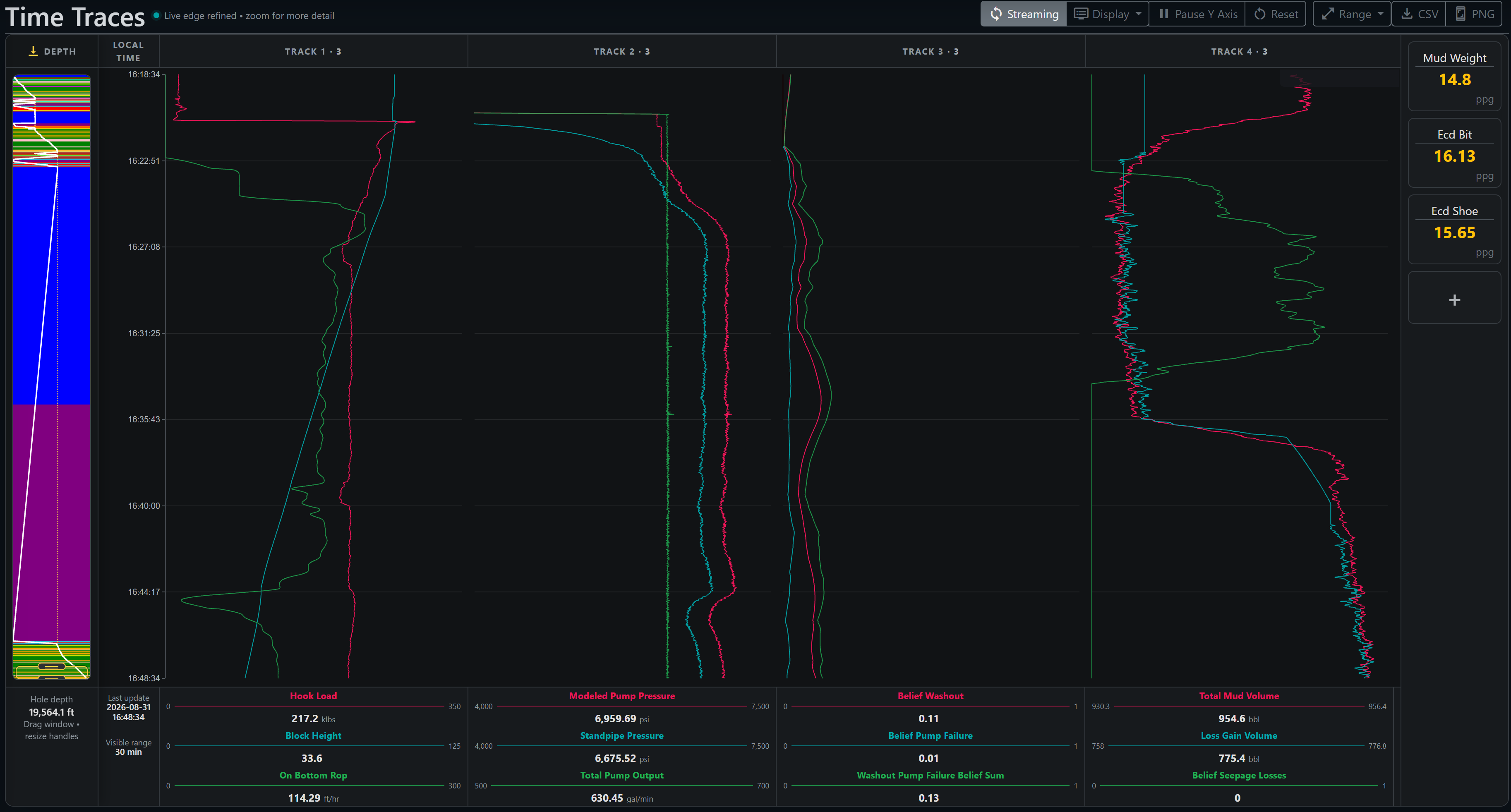
Useful event surveillance should preserve the underlying data needed to investigate why an abnormal condition was identified.
Pressure Is the Symptom. The Hydraulic System Is the Diagnosis.
A falling standpipe pressure is important.
But it is not a diagnosis.
A drillstring washout changes the hydraulic path through the well.
A failing pump changes the amount of fluid actually delivered into that path.
A bad sensor changes only our observation of the process.
Those differences create different signatures across:
- pressure,
- flow,
- pump behavior,
- model predictions,
- and time.
The strongest real-time interpretation comes from combining those signals rather than searching for one perfect alarm channel.
That leads to a broader rule for drilling intelligence:
When several physical processes can produce the same sensor response, the analytics should model the competing explanations—not simply alarm on the symptom.
References
-
Ambrus, A., Ashok, P., Ramos, D., Chintapalli, A., Susich, A., Thetford, T., Nelson, B., Shahri, M., McNab, J., and Behounek, M. Self-Learning Probabilistic Detection and Alerting of Drillstring Washout and Pump Failure Incidents During Drilling Operations. IADC/SPE-189700-MS, IADC/SPE Drilling Conference and Exhibition, Fort Worth, Texas, 2018.
-
Shahri, M., Kutlu, B., Thetford, T., Nelson, B., Wilson, T., Behounek, M., Ambrus, A., and Ashok, P. Adopting Physical Models in Real-Time Drilling Application: Wellbore Hydraulics. SPE-191797-MS, SPE Liquids-Rich Basins Conference—North America, Midland, Texas, 2018.
-
Ashok, P., Ambrus, A., Ramos, D., Lutteringer, J., Behounek, M., Yang, Y. L., Thetford, T., and Weaver, T. A Step by Step Approach to Improving Data Quality in Drilling Operations: Field Trials in North America. SPE-181076-MS, SPE Intelligent Energy International Conference and Exhibition, Aberdeen, United Kingdom, 2016.