Long-Horizon Hole-Cleaning Surveillance from Surface Drilling Data

Hole condition reflects the recent history of circulation, cuttings generation, static time, pipe movement, hydraulics, and tight spots—not just what the pumps are doing right now.

A drilling engineer looking at a well at 2:00 PM might see:

  • pumps on,
  • acceptable flow rate,
  • pipe rotating,
  • and no obvious drag problem.

Does that mean the hole is clean?

Not necessarily.

An hour earlier, the rig may have drilled aggressively at high ROP with marginal circulation.

Before that, the string may have remained static long enough for cuttings to settle.

The crew may then have circulated briefly before resuming drilling.

What is happening at 2:00 PM matters.

But so does what happened at noon.

And at 10:00 AM.

That is what makes hole cleaning fundamentally different from many instantaneous drilling calculations.

Hole condition has memory.

A useful real-time surveillance system therefore has to preserve some representation of recent operating history rather than judging the wellbore from one snapshot.

SPE-204125 presented an approach built around exactly this idea. Instead of attempting to calculate the precise height or distribution of a cuttings bed, the methodology evaluates whether recent drilling and hole-cleaning operations provide evidence of favorable or unfavorable hole conditions.[1]

This distinction is important.

The goal is not to claim knowledge of something that surface sensors cannot directly observe.

The goal is to use the operational evidence that is available to assess whether the way the well has been operated is consistent with effective hole cleaning.

Horizontal wellbore showing how high-ROP drilling, static time, resumed circulation, reaming, and rotary drilling history influence the current hole-condition assessment.

Hole condition reflects the accumulated effects of recent drilling, inactivity, circulation, and pipe movement.

Why Instantaneous Flow Rate Is Not Enough

Flow rate is obviously important to cuttings transport.

But it does not tell the entire story.

Consider two wells currently circulating at exactly the same pump output.

Well A

For the previous several hours:

  • ROP was moderate,
  • pipe rotation was maintained,
  • circulation remained strong,
  • little static time accumulated,
  • and the crew worked the pipe before the trip.

Well B

For the previous several hours:

  • ROP increased substantially,
  • flow remained unchanged,
  • the string then sat static,
  • and no significant reaming or off-bottom circulation occurred.

At the current instant, the pump rates may be identical.

The recent histories are not.

The amount and location of cuttings in the annulus may therefore be very different.

This is one reason instantaneous thresholds are limited.

A flow-rate threshold can answer:

Is the current circulation rate above or below a selected transport criterion?

It cannot by itself answer:

What hole condition has developed as a result of the preceding several hours of operation?

The distinction is central to long-horizon surveillance.

Cuttings Generation and Cuttings Removal Are Competing Processes

Drilling creates solids.

Circulation transports them.

The balance between those two processes matters.

A simple conceptual way to think about hole cleaning is:

$$\text{Hole Condition} \sim \text{Cuttings Generated} - \text{Cuttings Removed}$$

That is not a mechanistic cuttings-transport equation.

It is a useful mental model.

ROP influences the rate at which new cuttings are introduced into the annulus.

Flow, fluid properties, pipe rotation, inclination, hole geometry, and other variables influence transport.

This means a pump rate that is adequate at one ROP may become less favorable when ROP increases substantially.

SPE-204125 includes a field example where ROP increased while pump output remained approximately constant, causing the model's assessment of sufficient circulation to deteriorate.[1]

That does not mean high ROP is inherently harmful.

It means cuttings generation increased without a corresponding increase in one of the primary transport inputs.

That relationship is more meaningful than evaluating either ROP or flow rate by itself.
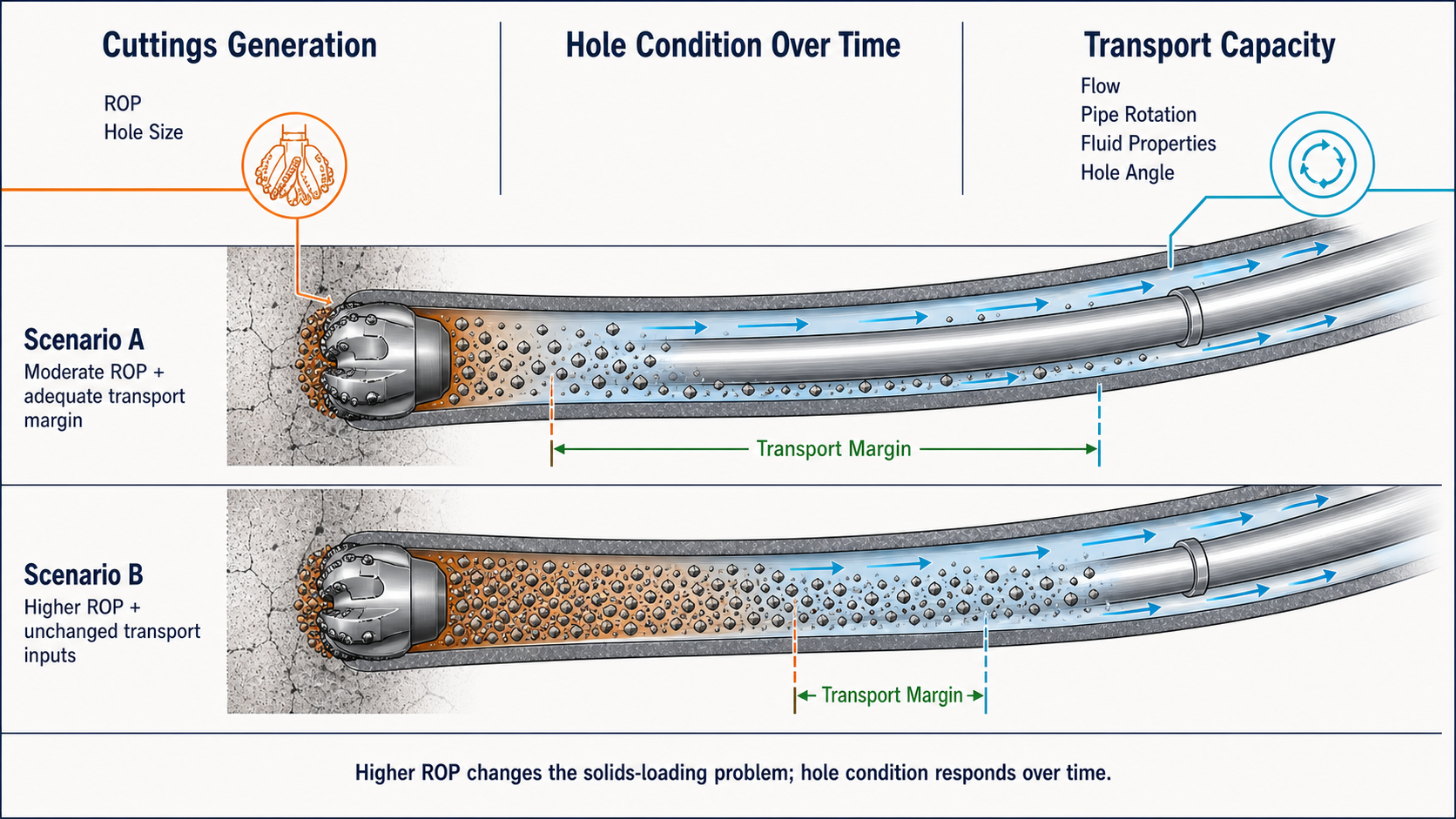
Two-scenario high-angle wellbore comparison showing moderate and higher ROP against unchanged transport inputs, with the transport margin narrowing as cuttings generation increases.

An increase in drilling rate changes the cuttings-loading problem even if every hydraulic set point remains unchanged.

A Mechanistic Model and an Operational Surveillance Model Answer Different Questions

Detailed cuttings-transport models can be extremely valuable.

Depending on the model, they may attempt to estimate quantities such as:

  • critical transport velocity,
  • cuttings concentration,
  • bed height,
  • slip velocity,
  • or the transient distribution of solids along the wellbore.

But detailed models have a cost.

They require inputs.

Some of those inputs may be:

  • uncertain,
  • updated only intermittently,
  • unavailable in real time,
  • or difficult to measure accurately at the rig.

SPE-204125 deliberately takes a different approach.[1]

Instead of asking:

What is the cuttings-bed height at 14,500 ft?

it asks something closer to:

Has the recent operating history been consistent with effective hole cleaning?

That is a less ambitious physical claim.

But it may be more defensible with ordinary surface drilling data.

The two approaches are not mutually exclusive.

A mechanistic model attempts to represent the physical transport process.

A long-horizon surveillance model attempts to interpret operational evidence.

The distinction is similar to weather forecasting and observing whether conditions are deteriorating: both are useful, but they answer different questions.

What Evidence Can Surface Data Provide?

The SPE-204125 methodology identified several categories of operational evidence relevant to hole-cleaning assessment.[1]

They can be understood without reproducing the specific implementation.

1. Circulation adequacy

Has circulation been maintained at a level considered favorable for transporting cuttings?

The important word is maintained.

One good pump-rate reading does not erase hours of marginal circulation.

Duration matters.

2. Tight spots

Has the string encountered repeated abnormal drag or overpull while moving through the hole?

A tight spot is not proof of poor hole cleaning.

It can have other causes.

But repeated or increasing tight spots can provide evidence that hole condition deserves attention.

3. Static hole

Has the string remained stationary—or been out of the hole—for a meaningful period?

Without mechanical agitation, cuttings can settle according to the local geometry and fluid behavior.

The effect of static time is therefore cumulative.

4. Bit hydraulics

Have the conditions at the bit been favorable for moving newly generated cuttings away from the cutting structure and into the annulus?

This addresses a different part of the cleaning problem from bulk annular circulation.

5. Working the pipe

Has the crew reamed or otherwise moved the string through the hole?

These actions can help disturb accumulated material and improve transport.

6. Pipe rotation

Rotation can improve cuttings transport in deviated and horizontal sections.

Again, the useful question is not whether the pipe is rotating at this exact second.

It is whether meaningful rotation has occurred over the period relevant to hole condition.

7. Circulating without drilling

When circulation occurs without generating new cuttings, the operation has an opportunity to remove existing solids without adding more.

This can represent an intentionally proactive hole-cleaning action.

Circular systems-engineering infographic showing seven surface-evidence groups contributing to a hole-cleaning assessment, with hole angle as the contextual outer ring.

Surface measurements do not observe a cuttings bed directly, but they provide multiple independent indicators of whether recent operations have favored or challenged hole cleaning.

Why Hole Angle Changes the Interpretation

Cuttings transport is strongly dependent on inclination.

A vertical hole and a high-angle lateral do not respond to solids in the same way.

As inclination increases, gravity increasingly acts across the hole rather than along it.

That changes:

  • settling behavior,
  • bed development,
  • sensitivity to pipe rotation,
  • and the effectiveness of various cleaning practices.

For that reason, SPE-204125 incorporates hole angle as contextual information when interpreting the event history.[1]

This is another example of why drilling analytics require context.

The same:

  • pump rate,
  • rotation rate,
  • static duration,

can have different significance at 10° inclination and 90° inclination.

A useful surveillance system therefore cannot simply count events.

It has to interpret them in the physical context of the current hole section.

Hole Cleaning Has Both Negative and Positive Evidence

One of the more useful aspects of long-horizon analysis is that it can recognize proactive actions, not only adverse symptoms.

Many surveillance systems are designed around negative evidence:

  • pressure too high,
  • torque too high,
  • drag too high,
  • flow too low.

Hole-cleaning practices are different because the crew can actively improve the condition of the hole.

Examples include:

  • reaming,
  • circulating off bottom,
  • rotating the string,
  • working the pipe before a trip.

The SPE-204125 methodology explicitly includes these proactive events.[1]

This is important because two wells with similar adverse indicators may deserve different assessments if one has undergone substantial cleaning activity and the other has not.

A good surveillance model should therefore recognize both:

evidence of deterioration

and

evidence of remediation.

Two-sided engineering infographic showing adverse evidence and proactive hole-cleaning activity feeding a current hole-condition assessment while retaining the influence of prior adverse history.

Long-horizon surveillance can account for both adverse operating history and deliberate hole-cleaning actions.

Old Events Should Matter Less Than Recent Events

If the string sat static twelve hours ago but the crew has since:

  • circulated extensively,
  • rotated,
  • worked the pipe,
  • and drilled normally,

the earlier static period should not have the same influence as a static period that ended ten minutes ago.

That requires some concept of event aging.

SPE-204125 addresses this by reducing the influence of older events as time passes.[1]

The exact implementation is less important than the principle:

$$\text{Influence of Event} = f(\text{duration}, \text{frequency}, \text{age})$$

where recent and persistent events generally carry more useful information about current conditions than brief events far in the past.

This is what gives the model memory without making the memory permanent.

A good long-horizon indicator should remember what matters and gradually forget what no longer does.

Scientific timeline showing static time, marginal circulation, reaming, pipe rotation, and off-bottom circulation aging toward the current hole-condition assessment.

Event history should influence current assessment, but older events should gradually lose importance as subsequent operations change the hole condition.

Why Rig-State Detection Becomes Essential

To analyze this automatically, the software must understand what the rig is doing.

Consider these operations:

  • drilling,
  • circulating,
  • reaming,
  • backreaming,
  • tripping,
  • connection,
  • static.

The same surface channels mean different things in each state.

For example:

Pumps on + no new hole

could represent beneficial off-bottom circulation.

Pumps on + bit advancing

means cuttings are being generated at the same time they are being transported.

Rotation + no drilling

may represent a proactive cleaning action.

No movement + pumps off

creates a very different hole-cleaning condition.

Raw WITS or EDR channels do not naturally contain these engineering meanings.

They have to be inferred from the behavior of:

  • bit depth,
  • hole depth,
  • block position,
  • pumps,
  • RPM,
  • hook load,
  • and related measurements.

This is why operational-state classification acts as a semantic layer between raw rig data and higher-level drilling analytics.

Without it, the surveillance system sees measurements.

With it, the system begins to see operations.

A Short Static Period and a Long Static Period Are Not Equivalent

Consider two events.

Event A

The pumps are off and the string does not move for 90 seconds during a routine transition.

Event B

The well remains static for three hours.

Both could technically be labeled:

Static

But their potential importance to hole condition is completely different.

The same is true for:

  • five minutes of circulation,
  • versus an hour of circulation;

or:

  • briefly rotating while staging pumps,
  • versus sustained high-rate rotation while working the hole.

This is why simply counting operational events is not enough.

Duration and frequency matter.

Long-horizon analysis transforms discrete rig-state events into features that represent how much of a particular condition has occurred recently.

That is a much more useful representation for a process like hole cleaning.

Tight Spots Are Evidence, Not a Verdict

Repeated overpull can be a valuable sign that the hole condition is deteriorating.

But it is important not to reverse the logic.

A tight spot does not automatically mean:

poor hole cleaning.

High drag can also result from:

  • wellbore geometry,
  • ledges,
  • swelling formations,
  • differential sticking tendencies,
  • BHA geometry,
  • keyseating,
  • tortuosity,
  • or other mechanical conditions.

The proper interpretation is:

A repeated tight-spot pattern provides evidence consistent with a poor hole condition, particularly when other hole-cleaning indicators also deteriorate.

This is exactly why multi-factor approaches are more useful than single-channel alarms.

One symptom may be ambiguous.

Several physically related symptoms occurring together can create much stronger evidence.

High ROP Changes the Hole-Cleaning Problem

High ROP is desirable.

But the annulus does not care about drilling economics.

It sees solids.

If ROP increases significantly while:

  • pump rate remains unchanged,
  • rotation remains unchanged,
  • fluid properties remain unchanged,

the solids-loading problem has changed.

SPE-204125 includes a case where an increase in ROP at constant pump output changed the assessment of circulation adequacy.[1]

This creates a valuable operational insight:

A previously acceptable cleaning practice may become less favorable after a performance improvement.

That means drilling optimization and hole-cleaning surveillance cannot be completely separated.

If an optimization program successfully increases ROP by 30%, the hole-cleaning requirements should be reassessed rather than assumed unchanged.

A Practical Long-Horizon Example

Consider a hypothetical lateral.

06:00–09:00

The rig drills steadily.

ROP gradually increases.

Pump output remains constant.

Pipe rotation remains high.

No unusual drag is observed.

09:00–10:30

ROP becomes substantially higher.

No corresponding increase is made to circulation.

10:30–12:00

Operations stop.

The string remains largely static.

12:00–12:45

The crew resumes circulation and begins moving the pipe.

12:45–13:30

The crew reams and rotates off bottom.

13:30

Drilling resumes.

What is the hole condition at 13:31?

Looking only at the current instant:

  • pumps are on,
  • pipe is rotating,
  • drilling has resumed.

Everything may look normal.

A long-horizon assessment sees more:

  • increased cuttings generation,
  • extended static time,
  • followed by a period of proactive cleaning.

The correct conclusion may not be:

hole is poor

or

hole is clean.

It may be:

Recent history increased the risk of poor hole condition, but subsequent proactive cleaning has improved the evidence. Continue monitoring the response during drilling and the next pipe-movement event.

That is much closer to how an experienced drilling engineer reasons. Synthetic eight-hour timeline aligning ROP, pump rate, surface RPM, rig state, and a conceptual hole-cleaning condition assessment across drilling, static time, proactive cleaning, and resumed drilling.
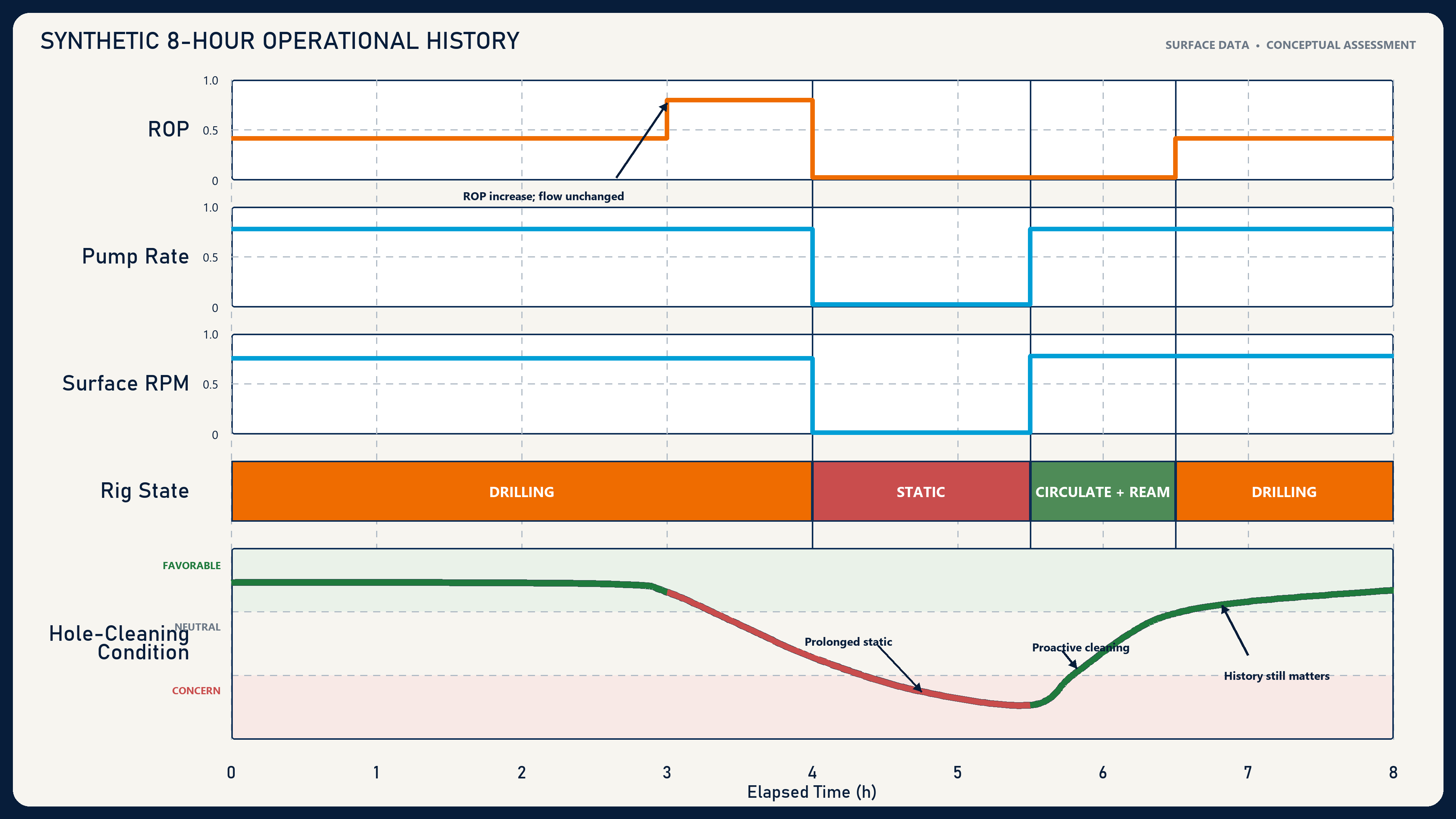
A long-horizon indicator can retain the influence of previous drilling activity while responding to subsequent proactive cleaning.

The First Trip After Drilling Provides New Evidence

Some hole-condition symptoms become clearer when the pipe is moved.

During drilling, cuttings accumulation may not produce an obvious surface indication.

During the subsequent trip, the crew may encounter:

  • overpull,
  • restricted movement,
  • pack-off tendencies,
  • increased drag,
  • or repeated tight zones.

That new evidence should update the assessment.

This is another reason a long-horizon model cannot operate only during rotary drilling.

The state of the hole is relevant across:

  • drilling,
  • circulation,
  • reaming,
  • static periods,
  • and tripping.

SPE-204125 includes a case where a substantial overpull encountered during a trip contributed to a deteriorating assessment of hole condition.[1]

The lesson is general:

Observations made during later operations can tell us something about the effectiveness of earlier hole-cleaning practices.

Proactive Actions Do Not Automatically Erase Poor Conditions

Suppose the surveillance indicates deteriorating hole condition.

The crew circulates for ten minutes.

Is the problem solved?

Not necessarily.

The significance of a proactive action depends on:

  • how severe the preceding evidence was,
  • how long the cleaning action lasted,
  • whether the pipe was moved,
  • whether rotation was effective,
  • the hole angle,
  • and what happens afterward.

SPE-204125 describes examples in which proactive cleaning actions improved the hole-cleaning assessment, but relatively limited actions were not always sufficient to overcome stronger adverse evidence.[1]

This is operationally important.

A system should not simply say:

Circulation occurred, therefore hole is clean.

The question is whether the amount and type of cleaning activity are sufficient relative to the recent history.

Two-panel engineering comparison showing strong hole-condition recovery after sustained reaming, pipe rotation, and extended circulation versus partial recovery after brief circulation only.

The effect of a proactive cleaning action should be interpreted relative to the severity and duration of the preceding hole-condition evidence.

A Useful Output Is a Trend, Not Just an Alarm

A binary alarm:

HOLE CLEANING POOR

has limited value by itself.

A trend provides more information.

For example:

  • condition stable,
  • gradually deteriorating,
  • strongly deteriorating,
  • recovering after reaming,
  • improving after extended circulation.

That lets engineers see cause and effect.

Did the assessment improve after:

  • increasing flow?
  • lowering ROP?
  • working the pipe?
  • rotating off bottom?

Or did the condition continue deteriorating despite those actions?

That information can support the next operational decision.

It also creates better post-well learning.

Instead of simply recording:

Stuck pipe at 14,800 ft

the engineer can review:

  • when the first adverse evidence appeared,
  • what operations preceded it,
  • what remedial actions were taken,
  • whether the response was measurable,
  • and whether similar patterns occurred on offsets.

The System Should Explain Why the Assessment Changed

If a hole-cleaning indicator deteriorates, the engineer needs to know why.

Potential contributors might include:

  • circulation becoming less favorable,
  • prolonged static time,
  • repeated tight spots,
  • deteriorating bit hydraulics,
  • reduced proactive pipe movement.

Likewise, if the condition improves, it is useful to know whether the improvement followed:

  • reaming,
  • rotation,
  • circulating without drilling,
  • or another operational change.

This makes the sub-indicators as important as the final score.

A single index is easy to monitor.

The underlying evidence is what makes it actionable.
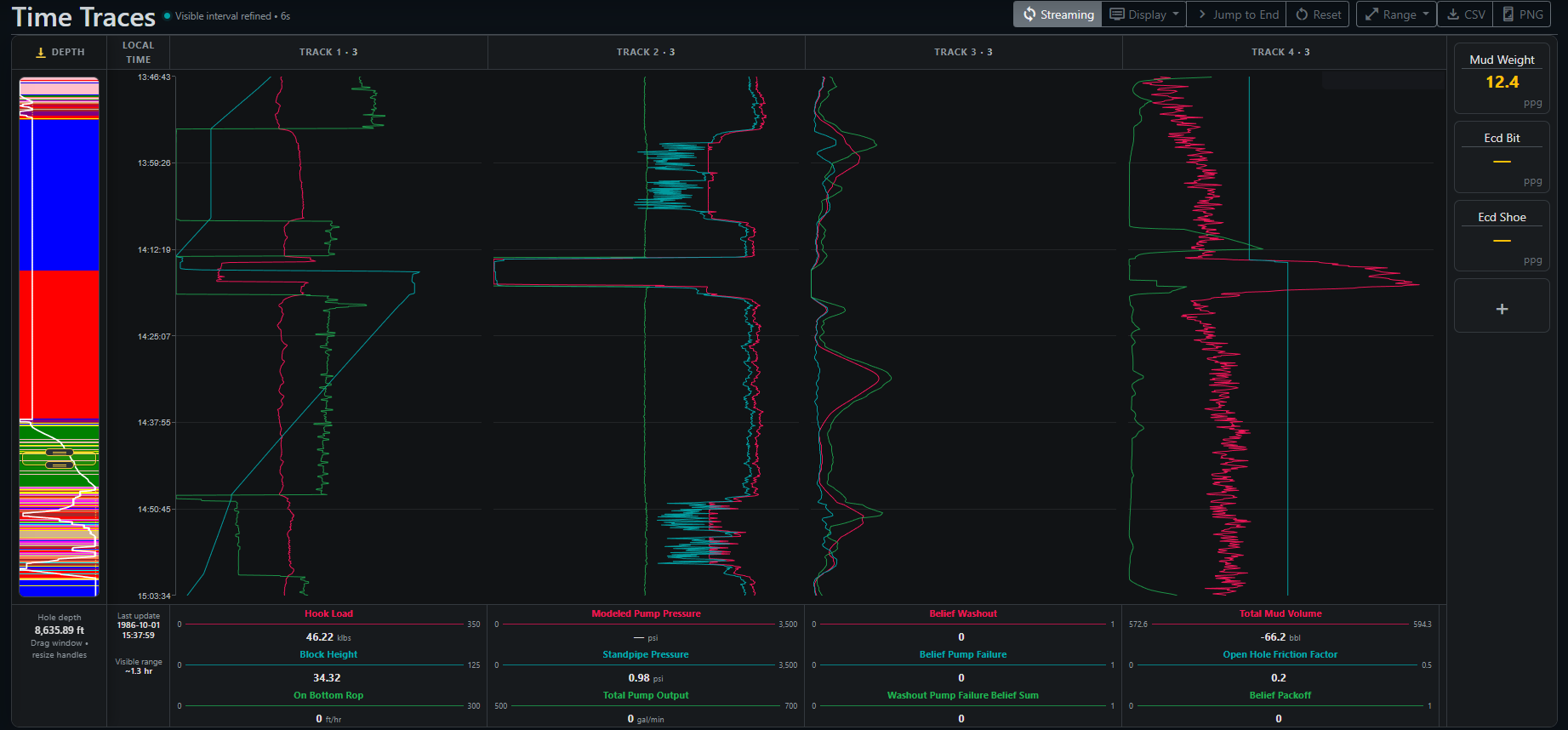
DrillingMetrics Time Traces view aligning depth, hook load, block height, ROP, pump pressure, pump output, volume, and other synchronized drilling channels across changing operational intervals.

A sequence of rig states and drilling parameters provides the operational history needed for long-horizon hole-condition analysis.

What This Approach Does Not Tell You

This limitation deserves to be explicit.

An event-based hole-cleaning assessment does not directly tell you:

  • the exact cuttings-bed height,
  • the exact solids concentration at every measured depth,
  • the precise location of accumulated cuttings,
  • or the exact probability of becoming stuck at a future time.

The SPE-204125 methodology deliberately avoids claiming that level of physical resolution.[1]

It assesses whether the observed operating history is consistent with effective or poor hole-cleaning practices.

That distinction protects the interpretation from false precision.

A high-confidence poor-hole-cleaning assessment means:

The operational evidence strongly suggests the recent drilling and cleaning history has been unfavorable.

It does not mean:

There is a 7.4-in cuttings bed at 15,320 ft.

The latter would require a very different model and supporting data.

Scientific infographic distinguishing the operational evidence that surface drilling data can support from exact downhole cuttings quantities it cannot directly measure.

Surface surveillance can combine operational evidence to assess whether recent hole-cleaning conditions were favorable or poor, but it does not directly measure the exact geometry or location of downhole cuttings accumulation.

Long-Horizon Analytics Need Good Event Detection

There is one more important dependency.

If the software misclassifies rig activity, the long-horizon history becomes wrong.

For example:

  • reaming incorrectly classified as drilling,
  • static time missed because block movement noise is interpreted as activity,
  • circulation without drilling incorrectly grouped with rotary drilling.

Those errors directly contaminate the event history.

That means long-horizon surveillance depends on:

  1. reliable surface data,
  2. accurate synchronization,
  3. correct rig-state classification,
  4. contextual data such as inclination and geometry,
  5. only then, event-history inference.

The quality of the high-level conclusion is limited by the semantic quality of the inputs beneath it.

From Real-Time Data to Operational Memory

Most drilling dashboards are very good at answering:

What is happening right now?

For many problems, that is enough.

Hole cleaning requires another question:

What has happened recently that still matters now?

Answering that requires a form of operational memory.

Not every historical event should persist forever.

Not every event deserves equal weight.

But the relevant recent sequence—drilling rate, circulation, inactivity, pipe movement, hydraulics, and drag—contains information about the current hole that an instantaneous sensor snapshot cannot provide.

That is the deeper value of long-horizon surveillance.

It turns real-time drilling data from a collection of current values into a history of operational consequences.

And for problems such as hole cleaning, that history may be where the most useful information resides.


References

  1. Ashok, P., D'Angelo, J., Ramos, D., Yi, M., Thetford, T., Younk, N., Bohlander, S., Shahri, M., and Behounek, M. A Probabilistic Belief System to Track the Cleanliness of a Hole in Real-time. SPE-204125, SPE/IADC Drilling Conference, 2021.