Formation is a confounder in nearly every drilling-performance comparison. The same WOB, RPM, BHA, and bit can produce different ROP, MSE, and directional response as rock properties change. Optimization should therefore establish a local geological baseline, detect transitions, and compare against formation-matched evidence without treating the rock as a universal explanation.
Same parameters do not create a controlled comparison
It is tempting to say:
We held WOB and RPM constant, so the ROP response shows a change in drilling efficiency.
Not necessarily. A controlled comparison requires the important external conditions to remain sufficiently comparable. If rock strength changes, the same WOB and RPM do not imply the same expected ROP. This matters whenever engineers compare:
- stands,
- wells,
- rigs,
- bits,
- BHAs,
- parameter trials.
If estimated UCS increases from 15 to 25 ksi while ROP falls and MSE rises at the same depth, the formation explanation becomes more plausible. But UCS itself may be uncertain. Possible sources include:
- laboratory core data,
- log-derived estimates,
- offset interpretation,
- regional models.
Those sources are not equivalent. A formation-aware system should preserve the type and uncertainty of its geological evidence rather than imply a perfectly known rock-strength curve.
Do not test across an uncontrolled boundary
Take this sequence:
| MD | WOB | RPM | ROP |
|---|---|---|---|
| 13,100 ft | 30 klbf | 120 | 170 ft/hr |
| 13,180 ft | Increased to 35 klbf | 120 | Not evaluated |
| 13,220 ft | 35 klbf | 120 | 220 ft/hr |
The immediate conclusion might be:
Increasing WOB improved ROP by 50 ft/hr.
If the formation top is interpreted near 13,200 ft and offsets consistently show higher ROP below it, the parameter and geological changes occurred almost simultaneously. The full improvement cannot be attributed cleanly to WOB.
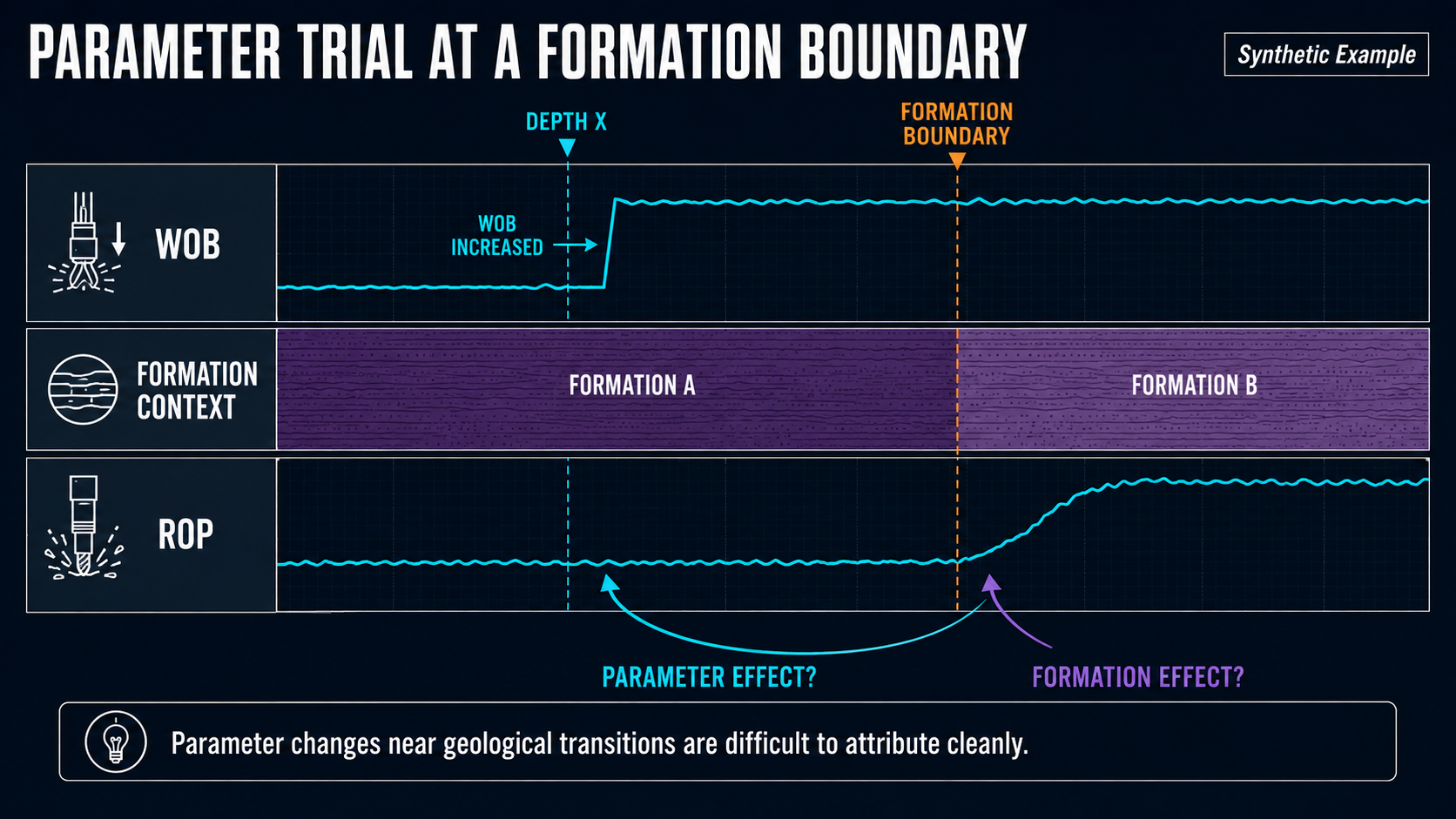
When a parameter change and a geological transition occur together, their separate effects cannot be attributed cleanly.
Rebaseline after material geological change
Historical rotary ROP of P50 = 210 ft/hr becomes more useful when conditioned by formation:
- Formation A: P50 = 245 ft/hr.
- Formation B: P50 = 175 ft/hr.
- Formation C: P50 = 215 ft/hr.
Now the current well can be compared with the population that better represents the rock being drilled. The benchmark has become conditional:
$$P(ROP|Formation)$$
rather than simply:
$$P(ROP)$$
This is one of the simplest ways to make performance analytics more physically meaningful. After 2,000 ft of stable drilling, the analytical system may have learned a local baseline for:
- ROP,
- torque,
- MSE.
Then the well enters a substantially harder rock package. If the old baseline continues unchanged, the system may repeatedly report:
performance deterioration.
The better approach is to detect or receive evidence of formation change, establish a new local baseline, and evaluate optimization relative to the new rock context.
This is closely related to the earlier article about moving windows and analytical memory. Memory should persist only while the physical context remains relevant.
Condition performance and directional response
The earlier nonlinear WOB–RPM article showed that drilling-performance landscapes can be:
- nonlinear,
- non-convex,
- locally defined.
Formation adds another dimension. Pooling observations from Formations A and B into one \(Performance=f(WOB,RPM)\) map may blend two different physical response surfaces. Better representations are:
$$Performance = f(WOB,RPM|Formation=A)$$
and:
$$Performance = f(WOB,RPM|Formation=B)$$
Those surfaces may have:
- different ROP levels,
- different inefficient regions,
- different dysfunction tendencies.
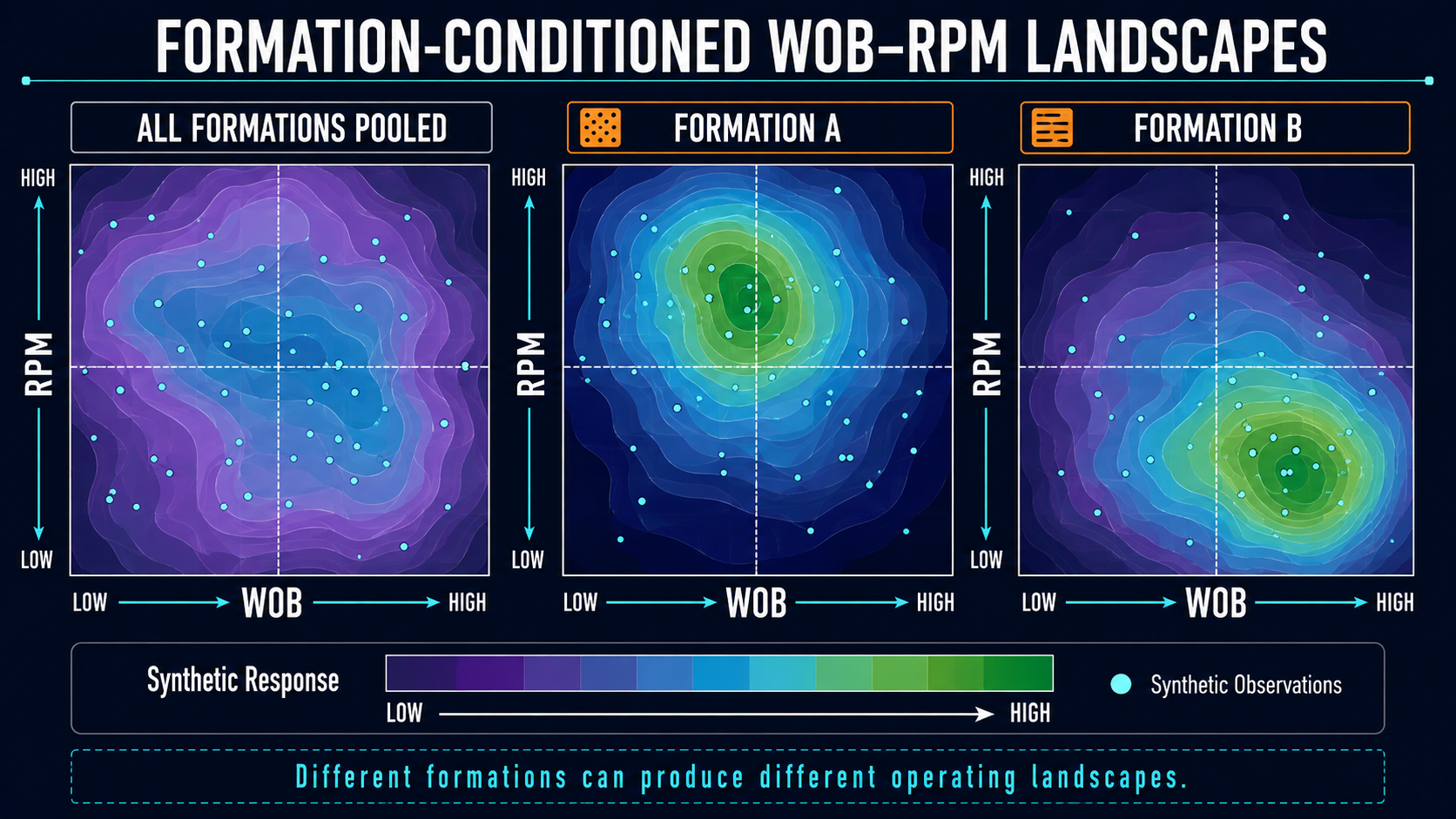
Pooling different rock packages can blur the operating landscape; formation-conditioned views reveal distinct response regions.
This is one of the most important reasons the article is broader than ROP optimization. A directional BHA's behavior depends not only on:
- geometry,
- stabilizer position,
- motor bend,
- bit design.
It also depends on the rock. SPE-196020 explicitly discusses formation hardness inside its BHA model. Harder formations can reduce bit steerability. The same bit and BHA can therefore produce different:
- build,
- drop
tendencies in different formations even with other factors nominally unchanged. A directional-performance change may therefore be a rock/BHA interaction rather than a BHA problem. If BHA A averaged 210 ft/hr mostly in faster Formation X and BHA B averaged 170 ft/hr mostly in slower Formation Y, the raw averages do not establish that BHA A is better.
Likewise, tortuosity comparison can be influenced by how much directional work was required and how the rock responded. This does not mean BHA comparisons are impossible. It means they should be conditioned on as many major physical differences as the data reasonably supports.
Align offsets geologically and retain uncertainty
Two wells at 13,500 ft MD are not necessarily drilling equivalent rock. Differences may arise from:
- structural position,
- trajectory,
- formation dip,
- TVD.
This is why offset analysis often includes:
- formation tops,
- depth shifting,
- geological alignment.
Published offset-comparison systems have explicitly provided both:
- depth adjustment,
- formation markers
for this reason. The objective is not merely:
Compare both wells at the same MD.
It is closer to:
Compare performance in the most geologically equivalent interval available.
There is an important counterpoint. Once formation context is introduced, it can become too convenient. ROP fell? Harder formation. Torque increased? Formation. Directional response changed? Formation. That is just as dangerous as ignoring geology entirely. Formation-aware analysis should condition the comparison, not eliminate other explanations. The correct question remains:
Given the rock we believe we are drilling, is the current response expected?
If not, investigate:
- bit,
- BHA,
- dysfunction,
- hole condition,
- hydraulics.
If ROP falls 25% at a formation transition, a geological explanation gains support from:
- formation top,
- gamma response,
- rock-strength increase,
- similar offset response.
If, at the same time:
- torque becomes severely erratic,
- MSE increases far more than offsets,
- dysfunction evidence appears.
Then geology may explain part of the change without explaining all of it. This suggests thinking in terms of evidence layers rather than single causes.
Practical formation-aware workflow
| Step | Engineering action |
|---|---|
| 1 | Identify rotary, slide, reaming, and other relevant rig states. |
| 2 | Resolve formation, gamma, lithology, and rock-strength evidence, including uncertainty. |
| 3 | Establish a local baseline for ROP, MSE, torque, and parameter response. |
| 4 | Detect geological transitions from interpreted tops, signal changes, and offset consistency. |
| 5 | Rebaseline after a material rock change rather than comparing new rock blindly with the preceding interval. |
| 6 | Compare with formation-matched offsets. |
| 7 | Investigate bit, BHA, dysfunction, hydraulics, and hole condition when performance remains poor relative to comparable rock. |
| 8 | Run parameter trials where geological context is reasonably stable. |
| 9 | Evaluate directional response separately from drilling speed. |
| 10 | Preserve uncertainty; do not present an interpreted formation boundary as exact ground truth. |
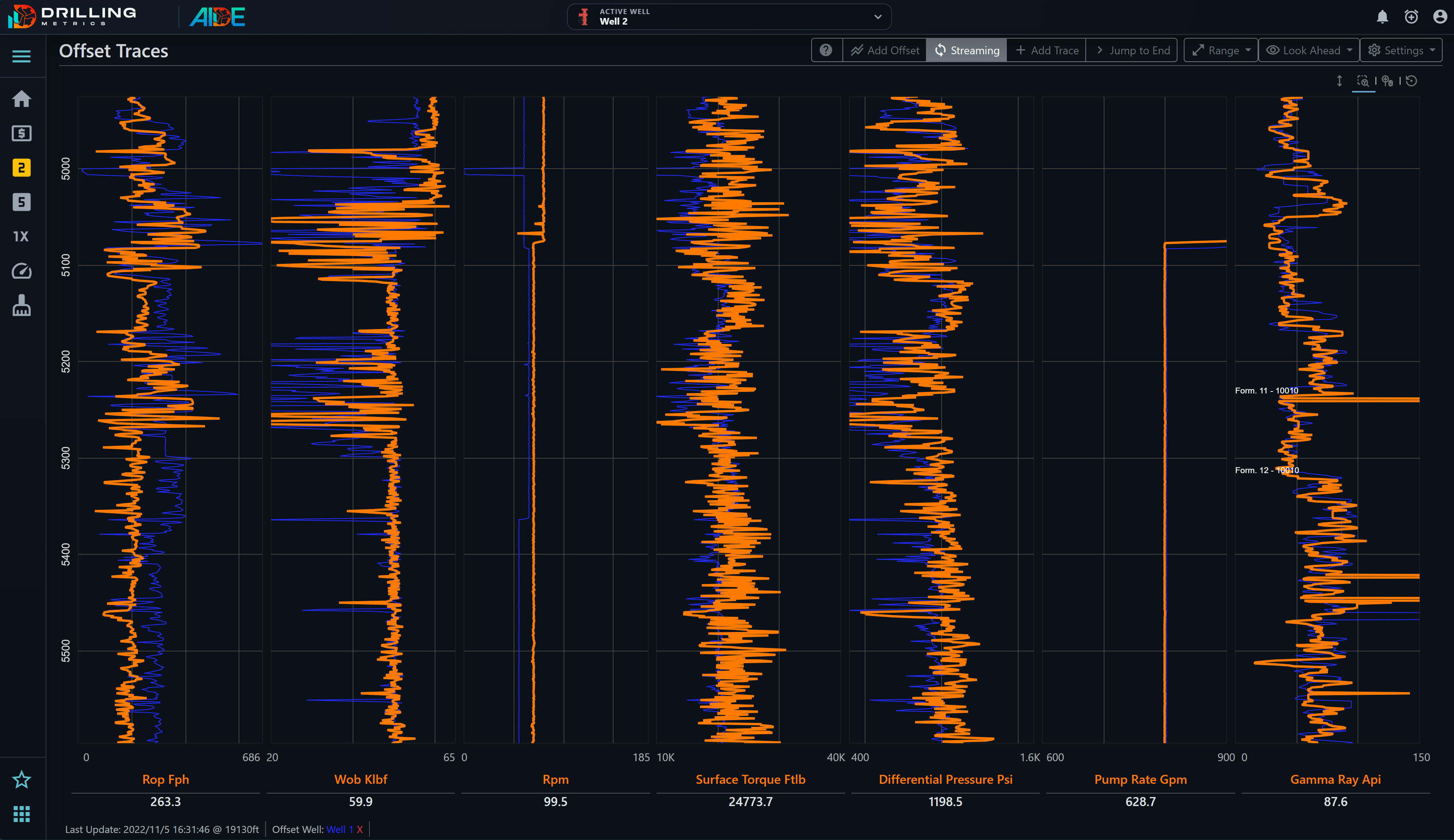
Formation markers provide a geological alignment reference while the traces retain the measured response and the uncertainty in exact equivalence.
Related technical resources
- Practical Considerations in Offset-Well Benchmarking
- Mechanical Specific Energy: Powerful Metric, Incomplete Diagnosis
- The Nonlinear WOB–RPM Performance Landscape
References
- Shahri, M., James, M., Vasicek, A., De Napoli, R., White, M., Behounek, M., D'Angelo, J., Ashok, P., and van Oort, E. Case Studies: Optimizing BHA Performance by Leveraging Data and Advanced Modeling. SPE-196020-MS, SPE Annual Technical Conference and Exhibition, Calgary, Alberta, 2019.